


IT Staff Augmentation Services: Why Most Companies Scale Engineering Wrong

Key Takeaways
I. The three ways companies hire wrong when scaling engineering
II. What IT staff augmentation services actually cover
III. Four things that separate outcomes-driven augmentation from CV placement
IV. What to demand from an IT staff augmentation provider
V. Why Systango for on-demand engineering workforce
When engineering delivery slows down, the instinctive response is to hire. Post a role, run interviews, onboard someone new, and wait for velocity to recover. For most scaling companies, this cycle repeats every quarter – and the delivery gap persists.
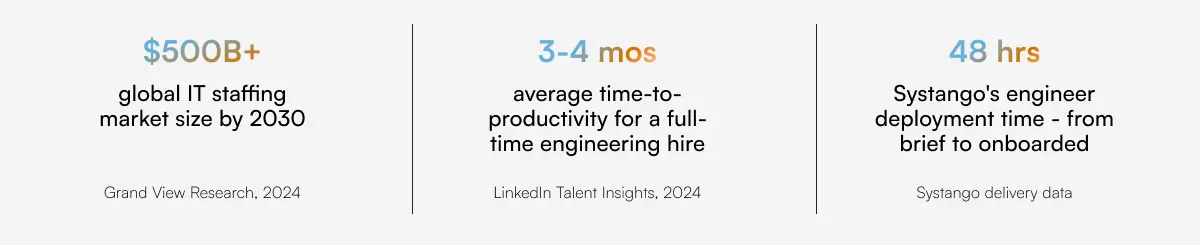
The problem is rarely headcount. It is the model used to add it. Full-time hiring takes 3-4 months to produce output. Freelancers lack context and continuity. Offshore agencies add coordination overhead that erodes the speed they were hired to create.
IT staff augmentation services exist to solve a specific version of this problem – giving engineering leaders access to vetted, technically strong talent that embeds into their team, works to their processes, and delivers from day one. This guide covers how to use them correctly, what to look for in a genuine dedicated development team model, and where most organisations go wrong when they try to scale engineering capacity.
I. The three ways companies hire wrong when scaling engineering
Most engineering scaling failures follow one of three patterns. Recognising which one is affecting your organisation is the prerequisite to fixing it.
1. Hiring for roles, not outcomes
The default hiring brief is a job description – a list of technologies, years of experience, and team fit criteria. What it rarely specifies is the delivery outcome the hire is accountable for. The result is engineers who are technically qualified but have no clear mandate, no defined success metric, and no structured accountability from day one. Output accountability must be defined before the hire, not after onboarding.
2. Confusing speed with quality in agency models
Staff augmentation agencies that promise 48-hour placements often deliver CVs, not engineers. The difference is significant. A CV-screened contractor joins your team without deep technical vetting, cultural alignment, or understanding of your delivery context. You spend the first month managing them rather than receiving output from them. This is not a speed problem – it is a selection problem dressed as a speed problem.
3. Treating augmentation as a cost play
The most common reason IT staff augmentation engagements underperform is that they were procured on price. Lower day rates mean less experienced engineers, less rigorous selection, and less delivery governance. The correct frame is capability-per-pound, not cost-per-day. A senior engineer embedded into your team for three months who accelerates a critical release delivers more value than two junior contractors who need constant direction.
II. What IT staff augmentation services actually cover
1. Staff augmentation
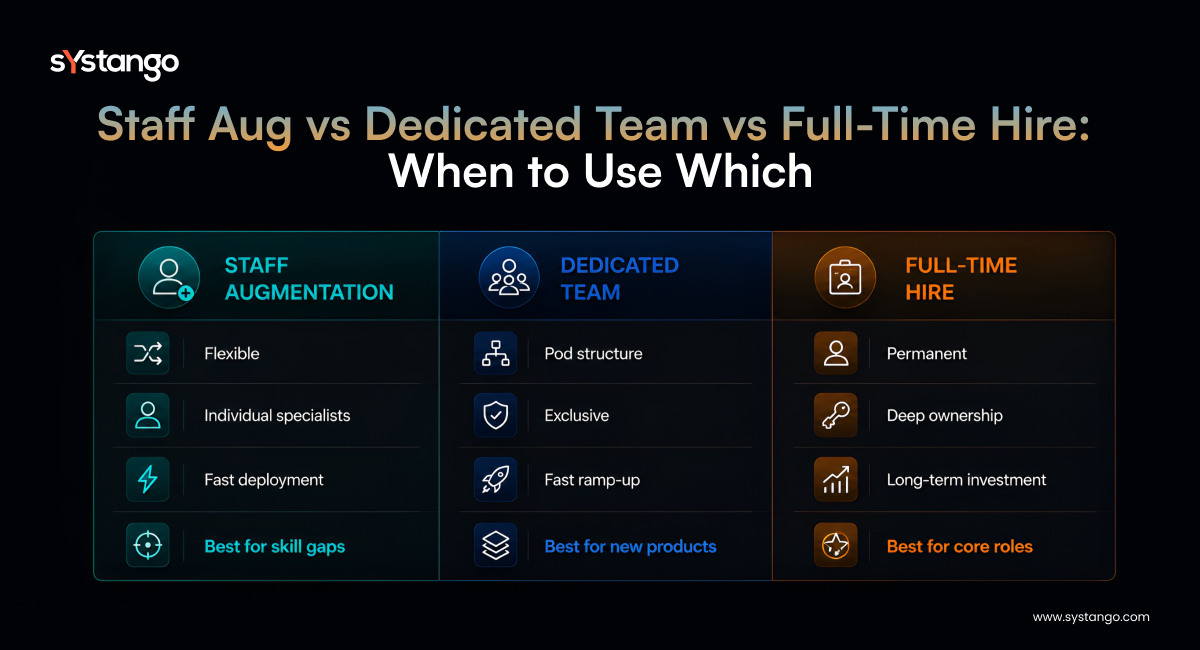
Staff augmentation services place individual engineers or specialists directly into your existing team – working to your processes, your tools, and your timelines. The engagement is flexible, typically monthly or project-based, and scales up or down as priorities change. The critical differentiator from freelancing is governance: a genuine IT staff augmentation provider assigns an account owner who tracks delivery KPIs, manages performance, and ensures alignment throughout.
2. Dedicated development teams
A dedicated development team is a pre-formed pod of engineers – typically 3-8 people – who work exclusively on your product or platform. Unlike augmented individuals who slot into an existing team, a dedicated team brings its own internal structure: tech lead, developers, QA, and sometimes a delivery manager. This model suits organisations building new products, running parallel workstreams, or scaling a specific capability without restructuring their existing team.
3. Team-as-a-Service and hybrid models
For organisations that need ongoing engineering capacity without the overhead of full-time employment, Team-as-a-Service provides a managed engineering function on a retainer model. You define the output and the capacity; the provider handles selection, onboarding, performance management, and continuity. Hybrid models combine augmented individuals with dedicated pods – typically used by organisations running core product teams internally while augmenting specialist capability externally.
When to hire software developers vs augment
The decision to hire software developers full-time versus augment should follow a simple framework: if the role is strategic, long-term, and central to your core product, hire. If the need is specialist, time-bound, or capacity-driven, augment. Most engineering scaling problems involve a combination of both – and the organisations that perform best treat augmentation and permanent hiring as complementary levers, not competing choices.
III. Four things that separate outcomes-driven augmentation from CV placement
The IT staff augmentation services market is large and inconsistent. These are the four differentiators that determine whether an engagement delivers or disappoints:
- Multi-level technical vetting: every engineer should pass technical assessments, communication evaluations, and cultural alignment checks before being proposed. A provider that measures speed-to-CV is not vetting – they are filtering a database.
- 48-hour ramp-up with genuine readiness: pre-vetted engineers who have been assessed against your stack and delivery context can onboard within 48 hours without a productivity lag. This is the correct benchmark – not 48-hour CV delivery.
- Dedicated account ownership: every staff augmentation services engagement should include an assigned account owner who tracks delivery KPIs, manages performance issues proactively, and ensures the engagement stays aligned to your outcomes – not just your headcount count.
- AI-native and cloud-native capability: in 2026, generic engineering augmentation is insufficient for most growth-stage technology companies. Providers with genuine depth in AI, ML, cloud infrastructure, and data engineering deliver compounding value – engineers who can contribute to your most strategic workstreams, not just your backlog.
IV. What to demand from an IT staff augmentation provider
- Evaluating IT staff augmentation services requires going beyond day rates and LinkedIn profiles. The questions that matter:
- What does your technical vetting process look like – and how long does it take per engineer?
- Can you demonstrate engineers who have delivered measurable outcomes in similar technology stacks?
- Who is my account owner and what delivery KPIs are they accountable for?
- What is your process when an engineer is not performing – and how quickly can you replace them?
- Do your engineers have active certifications in the platforms we use (AWS, GCP, Azure)?
The best dedicated development team and augmentation engagements are not measured by headcount placed. They are measured by delivery velocity gained, cycle time reduced, and capabilities unlocked. Any provider that cannot articulate those outcomes in commercial terms is selling you resources, not results.
V. Why Systango for on-demand engineering workforce
Systango’s IT staff augmentation services follow an outcomes-first model: every engineer is multi-level vetted across technical capability, communication, and cultural alignment before being proposed. Engagements include a dedicated account owner who tracks partner KPIs, manages delivery governance, and ensures alignment throughout – not just at the start.
As a publicly listed AI-native digital engineering company – ISO 27001 certified, AWS Advanced Partner, and top 20 globally for Google’s Generative AI Services Specialisation – Systango provides staff augmentation services across AI and ML engineering, data platform engineering, cloud and infrastructure, full stack development, and DevOps. Engineers are available within 48 hours, with flexible engagement models from individual augmentation to complete dedicated development team pods.
Explore our On-Demand Workforce services to understand how we approach your specific engineering capacity challenge.