

Cloud Infrastructure Services: The Complete Guide for Business Tech Leaders
Last Updated on: June 9, 2026
Key Takeawys
I. The five disciplines of cloud infrastructure services
II. What cloud migration services actually involve
III. What separates a credible managed cloud services provider
IV. How to evaluate cloud consulting services and migration partners
V. Why Systango for cloud infrastructure and managed services
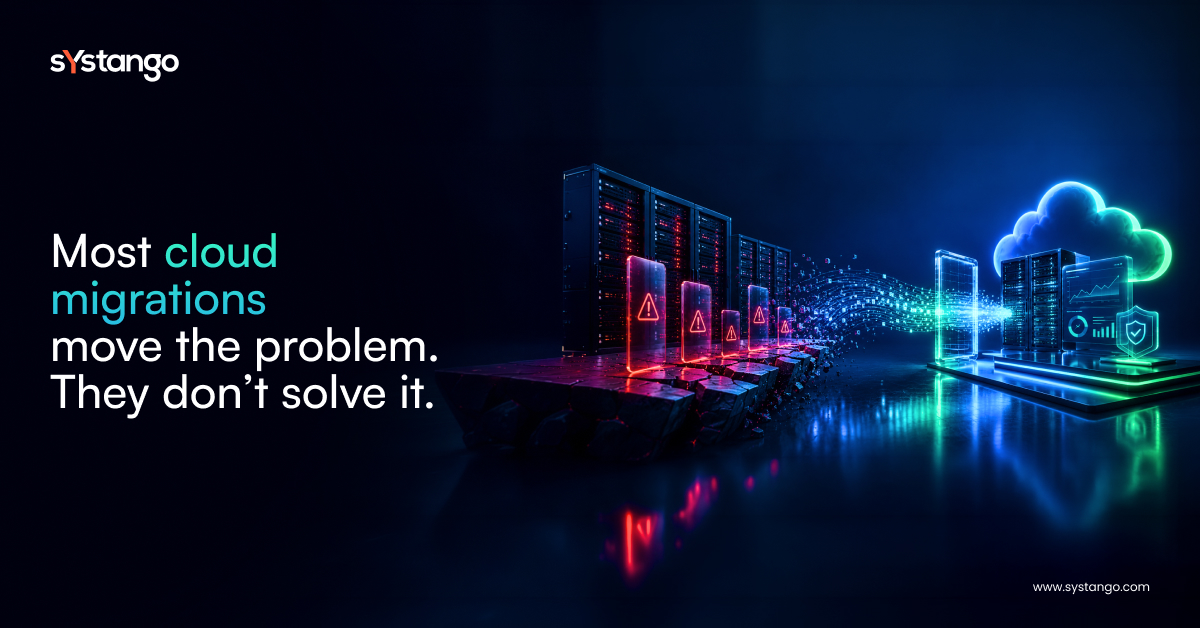
Most cloud migrations move the problem. They lift legacy infrastructure into a cloud environment without addressing the architecture, governance, or cost model that made the legacy system a liability in the first place. The result is cloud spend that compounds without a commensurate improvement in performance, resilience, or agility.
This guide covers the five disciplines of cloud infrastructure services, how to evaluate a managed cloud services provider, the four delivery phases that separate successful cloud programmes from expensive ones, and what to look for in cloud consulting services.
I. The five disciplines of cloud infrastructure services
Cloud infrastructure services cover five connected capabilities that together take an organisation from legacy infrastructure to a cloud platform that performs, scales, and compounds in value:
- Cloud consulting and strategy: Technology decisions made before any migration begins. Cloud readiness assessment, architecture design, platform selection (AWS, GCP, Azure), and governance framework. Cloud consulting services that skip this phase produce migrations that solve the wrong problem.
- Cloud migration: Moving workloads, data, and applications from on-premise or legacy cloud environments to a target architecture with minimal downtime and zero data loss. The 6Rs framework (rehost, replatform, refactor, rearchitect, retire, retain) determines the right migration approach per workload.
- Cloud-native development: Building or re-architecting applications for cloud-native deployment – containers, Kubernetes, serverless, and Infrastructure as Code. Cloud-native architecture is the difference between infrastructure that scales automatically and infrastructure that requires manual intervention at every growth threshold.
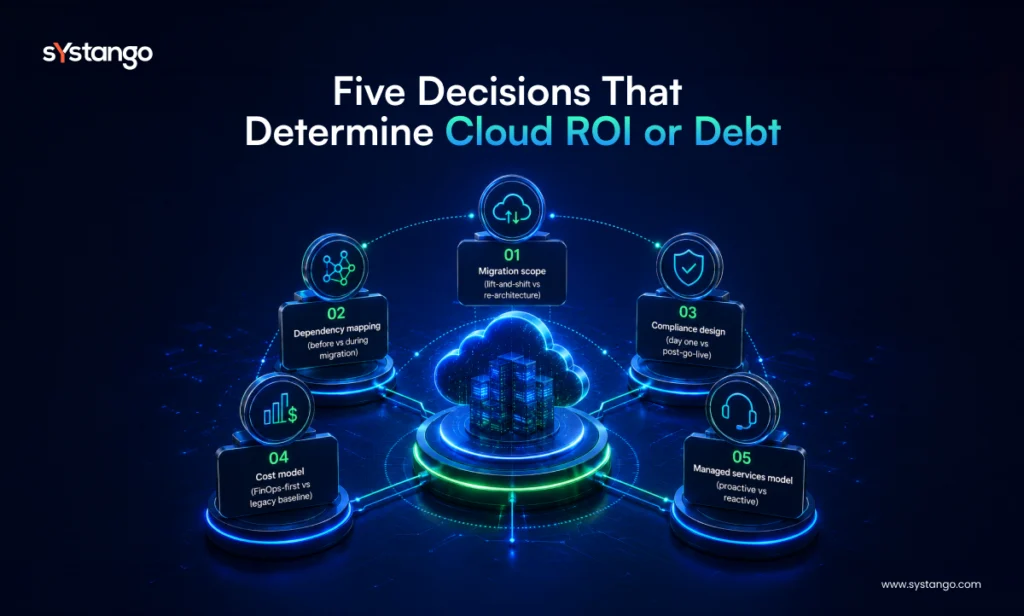
- Managed cloud services: Ongoing operational management of cloud infrastructure – 24/7 monitoring, incident response, cost control, performance tuning, and SLA management. A credible managed cloud service provider reduces infrastructure management overhead while improving reliability and visibility.
- Cloud security and compliance: Zero-trust architecture, encryption, identity and access management, and audit-ready governance for GDPR, DORA, FCA, and HIPAA requirements. Security designed after migration is significantly more expensive than security designed before it.
II. What cloud migration services actually involve
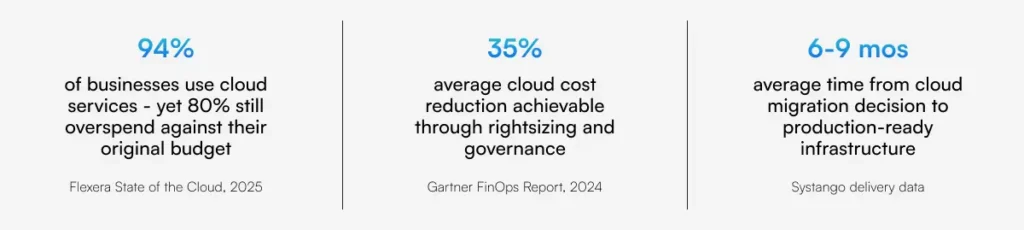
Cloud migration services are the most misscoped engagement in business technology. Most organisations budget for the lift – moving workloads to cloud infrastructure – and discover mid-migration that the real cost is the re-architecture required to make those workloads perform reliably in a cloud environment.
Four patterns consistently determine migration outcomes:
- Application dependency mapping before migration, not during. Unknown dependencies between applications are the single most common cause of migration delays. A credible cloud migration services partner maps every dependency before the first workload moves.
- Governance and compliance from discovery, not post-migration. Regulated industries – FinTech, InsurTech, Legal Tech – cannot go live without an audit-ready infrastructure. Compliance retrofitted after migration means re-engineering live systems.
- Cost model designed for the target state, not the legacy baseline. Lift-and-shift migrations consistently overspend because the cost model assumes cloud infrastructure runs like on-premise. Reserved capacity, auto-scaling, and FinOps governance must be designed in from the start.
- Runbook and operational handover as a delivery deliverable. A migration that ends at go-live without a complete operational runbook leaves the client dependent on the migration partner indefinitely. The runbook is a first-class deliverable, not a post-project document.
III. What separates a credible managed cloud services provider
The managed cloud services market is crowded. Most providers offer monitoring and incident response. Fewer build the operational intelligence layer that makes cloud infrastructure genuinely self-improving over time. Five criteria separate a credible managed cloud services provider from a break-fix helpdesk:
- Proactive cost governance: not just reactive cost reporting. FinOps-aligned rightsizing, reserved capacity recommendations, and idle resource detection before the invoice arrives.
- Security posture monitoring as standard: continuous compliance checks against CIS benchmarks, automated remediation for configuration drift, and audit-ready reporting for GDPR, DORA, and FCA.
- SLA transparency: defined response times, escalation paths, and named accountability for every service tier. SLAs that do not specify remedies for breaches are marketing documents.
- Observability stack included: distributed tracing, log aggregation, and performance dashboards that give engineering teams visibility into what the infrastructure is doing in real time.
- Runbook ownership: the managed services team maintains living operational documentation that transfers knowledge, not dependency.
IV. How to evaluate cloud consulting services and migration partners
Five questions that separate a genuine cloud consulting services partner from a reseller with a migration practice:
- Do they hold active cloud certifications – AWS Advanced Partner, Google Cloud specialisation – with named delivery engineers, not just partnership logos?
- Can they demonstrate production cloud deployments with specific outcomes: uptime improvements, cost reductions, migration timelines met?
- Do they design for governance and compliance from discovery – or treat it as a post-migration consideration?
- Is managed services included post-migration as a defined engagement, or does the relationship end at go-live?
- Is their delivery framework structured around reducing migration risk, or optimised to start billing quickly?
V. Why Systango for cloud infrastructure and managed services
Systango is a publicly listed, ISO 27001-certified cloud engineering company with 18 years of delivery. As an AWS Advanced Partner and Top 20 globally for Google’s Generative AI Services Specialisation, Systango delivers cloud migration services, managed cloud services, and cloud consulting services for growth-stage and organisations across FinTech, InsurTech, WealthTech, and regulated industries in the UK and globally.
Our four-phase delivery framework – Discover & Assess, Architect & Build, Migrate & Deploy, Monitor & Optimise – is designed to close the gap between cloud ambition and cloud performance. Every engagement includes governance, security, and FinOps as first-class deliverables, not optional add-ons.
Explore our Cloud & Infrastructure services to understand how we approach your specific cloud infrastructure services challenge.