

The Software Graveyard: Why Traditional SDLC Is Quietly Killing Your Business
Key Takeaways
I. The Assembly Line That Was Never Designed for Speed
II. Stage by Stage: Where Traditional SDLC Breaks Down
III. The True Cost – What Never Appears on the Invoice
IV. The Client Impact Nobody Wants to Acknowledge
There is a graveyard that no one talks about in boardrooms. It is not filled with headstones. It is filled with half-finished software projects, abandoned roadmaps, burnt-out engineering teams, and invoices that never quite matched the value delivered.
According to the Standish Group CHAOS Report, only 35% of software projects are considered successful – delivered on time, on budget, and with the originally promised features. The remaining 65% are either significantly compromised or fail outright. In an era where every business is, functionally, a technology business, that is not a statistic. It is a crisis.
The uncomfortable truth is this: for most organisations, the way software is built has not fundamentally changed in decades. The tools have evolved. The terminology has shifted. But the underlying machinery – the processes, the handoffs, the decision-making model – remains stubbornly, expensively manual.

I. The Assembly Line That Was Never Designed for Speed
Traditional SDLC – whether waterfall, early agile, or some hybrid variation – was built for a world where requirements were stable, change was slow, and the cost of getting it wrong was survivable. That world no longer exists.
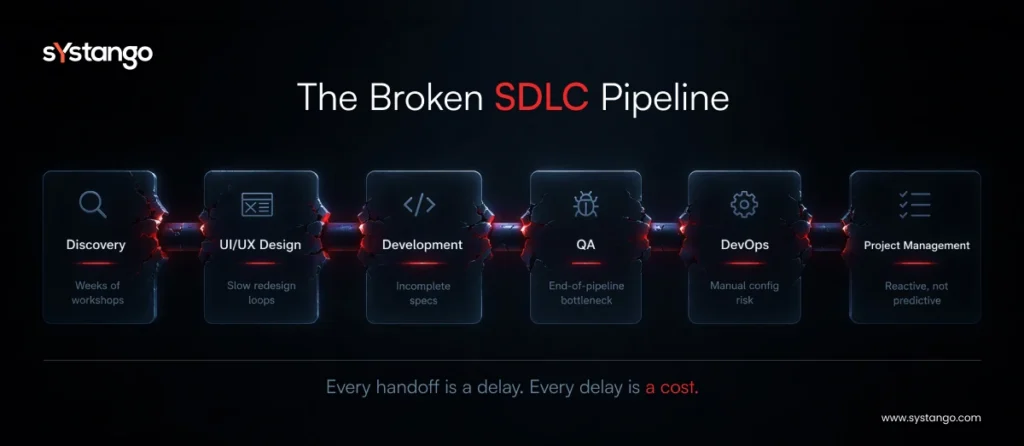
Modern businesses operate in an environment where market conditions shift in weeks, customer expectations evolve in months, and competitive advantage disappears in quarters. The assembly-line model of software development introduces lag at every single stage. Discovery feeds design, which feeds development, which feeds testing, which feeds deployment. Each handoff is a delay. Each delay is a cost.

II. Stage by Stage: Where Traditional SDLC Breaks Down
Discovery & Business Analysis
In a traditional environment, discovery begins with workshops, stakeholder interviews, and requirements-gathering exercises that can consume four to eight weeks before a single line of code is written. Requirements documents are drafted, reviewed, revised, and revised again. By the time they are signed off, the business context that informed them has frequently shifted. Requirements become obsolete artefacts rather than living guides.
Business Analysts work in isolation from developers. Developers work in isolation from designers. The result is a chain of Chinese whispers that ensures the product being built diverges progressively from the product that was needed.
UI/UX Design
Design operates in its own silo, producing wireframes and prototypes that are passed to developers as static artefacts. Feedback loops between designers and developers are slow and asynchronous. Redesigns at this stage – which are common – cost significantly more than the same change made during discovery. The design-to-development handoff is consistently one of the most expensive failure points in the traditional SDLC.
Development
Developers work from specifications that are incomplete, ambiguous, or outdated. Context switching between features, bug fixes, and documentation requests fragments focus and destroys flow state. Code reviews are manual, inconsistent, and – under delivery pressure – often cursory. Technical debt accumulates silently, creating a mortgage on future velocity that is never fully disclosed to clients.
Quality Assurance
QA sits at the end of the pipeline, expected to catch every problem that has accumulated across every preceding stage. In practice, QA becomes a bottleneck rather than a quality gate. Test case creation is manual and time-consuming. Regression testing cycles consume days. Production bugs that escape QA cost, on average, five to ten times more to fix than defects caught during development.

DevOps & Deployment
Deployment in traditional environments involves manual configuration, inconsistent environment management, and processes that are part science and part institutional memory held by a small number of individuals. A single misconfiguration can – and regularly does – take production systems offline. Deployment becomes an event to dread rather than a routine capability.
Project Management
Project management throughout all of this is an exercise in estimation, re-estimation, and managing the gap between what was promised and what is actually happening. Status reporting consumes hours that should be spent solving problems. Decisions that require cross-functional input take days to make. Escalations arrive too late to prevent the damage they are escalating about.
III. The True Cost – What Never Appears on the Invoice
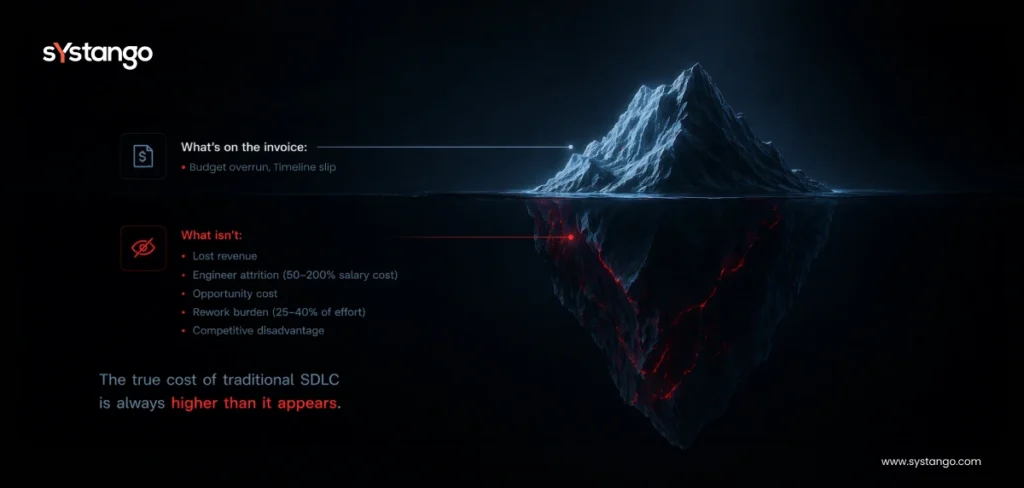
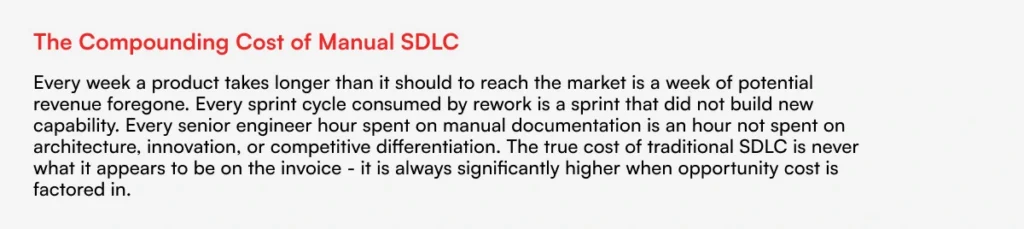
Beyond the visible metrics of time and money, traditional SDLC carries a hidden cost that is harder to quantify but equally damaging: the opportunity cost of slowness.
Developer attrition is an underreported dimension of this cost. Talented engineers do not leave because the work is hard. They leave because the work is frustrating – blocked by process, slowed by bureaucracy, and disconnected from the outcomes their effort is supposed to create. Replacing a senior developer costs between 50% and 200% of their annual salary when recruitment, onboarding, and lost productivity are properly accounted for.

IV. The Client Impact Nobody Wants to Acknowledge
For the businesses commissioning software the end clients the consequences of traditional SDLC manifest in ways that damage not just delivery outcomes but commercial relationships. When timelines slip, budgets expand, and promised features are discovered, trust erodes. And trust, once lost in a delivery context, is extraordinarily difficult to rebuild.
The clients most damaged by traditional SDLC are those in growth phases startups that needed their product in the market six months ago, scale-ups whose competitive window is narrowing, enterprises whose digital transformation programmes are running years behind schedule. For these organisations, the inefficiency of traditional software delivery is not an inconvenience. It is an existential risk.
The question every technology leader should be asking is not how much their current process is costing them. It is what they would be capable of if their process was not holding them back.