

The Clock Is Ticking: Why Every Month Without AI Governance Is Costing Your FinTech Business More Than You Think
Last Updated on: April 30, 2026
Key Takeways
1. The World Your Competitors Already Live In
2. The Cost of Inaction – A Number That Belongs in Front of Your Board
3. Systango AI Workbench – Built for the Specific Complexity of FinTech
4. Where AI Workbench Delivers Inside FinTech
5. Why the Window to Act Is Narrowing in 2026
6. Two external forces are making 2026 the critical inflexion point.
7. Three Actions You Can Take This Week
Here is a number your board needs to see: 40% of financial services firms that adopted AI tools in 2023–24 are now shipping products more slowly than before, according to Forrester research. Not the same speed. Slower. And the gap between AI-governed firms and ungoverned ones is compounding every quarter.
If your FinTech business is running AI tools without a governance backbone, you are not on a path to innovation. You are on a path to falling irreversibly behind and the window to course-correct is narrowing fast.
1. The World Your Competitors Already Live In
Your most aggressive competitors are not experimenting with AI. They have moved past experimentation into governed, production-grade deployment – compressing product development cycles from 9 months to under 12 weeks, as McKinsey research documents, running real-time fraud detection that learns from every transaction, and delivering AI-orchestrated customer experiences across every channel.

Firms still operating with ad hoc AI tools – no shared standards, no governance layer, no measurement framework are absorbing hidden costs that quietly erode their competitive position every sprint.
2. The Cost of Inaction: A Number That Belongs in Front of Your Board
Most FinTech leaders underestimate the cost of delayed AI governance because the costs are distributed, invisible in sprint retrospectives, and never appear as a single line item. But they are very real – and very calculable.
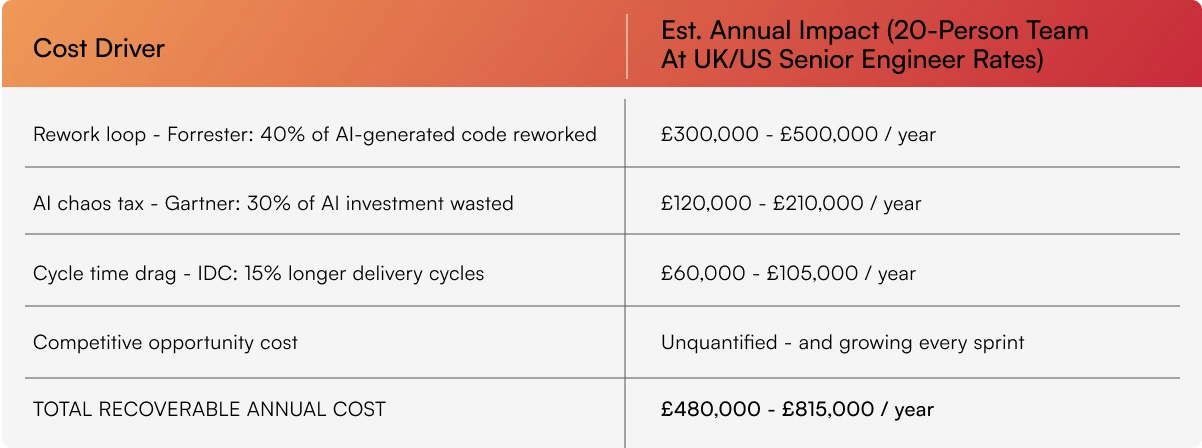
Cost 1 – The rework loop: 40% of your AI-generated code is being fixed twice
AI coding tools are trained on general-purpose codebases. FinTech systems run on jurisdiction-specific currency rounding rules, PCI DSS scope boundaries, and fraud detection logic that must hold under adversarial inputs. Forrester research found that in organisations without AI governance frameworks, approximately 40% of AI-generated code requires significant rework before it meets production standards – costing a 20-person team an estimated £300,000–£500,000 annually.
Cost 2 – The compliance queue: every developer speed gain is neutralised at the review gate
AI tools make your developers faster. They do nothing for the compliance review queue at the other end. When AI-generated code moves into FCA-regulated or OCC-scoped workflows without audit trail documentation, it creates a bottleneck that did not exist before. The FCA’s expectation is unambiguous: regulated firms must reconstruct how a decision was made, by whom or what, and on what basis.
Cost 3 – The AI chaos tax: 30% of your AI budget is being wasted right now
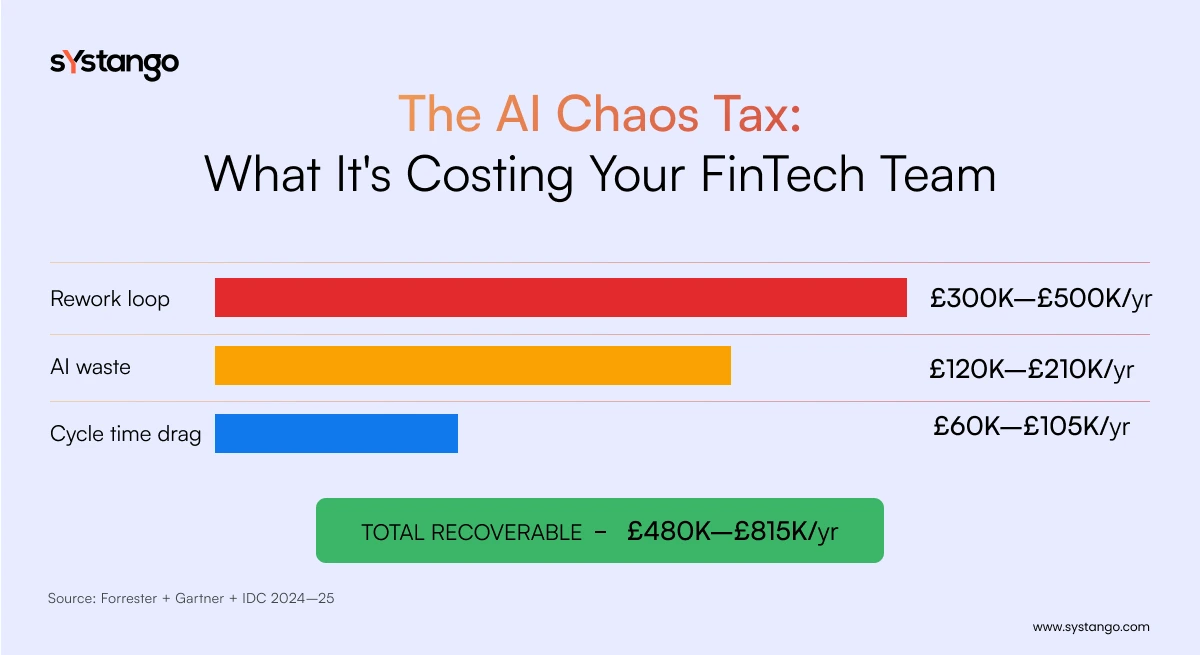
Gartner estimates that organisations with uncoordinated AI tool adoption waste up to 30% of their AI investment on overlapping capabilities, unused licences, and rework from inconsistent outputs.
IDC research found that teams running five or more uncoordinated AI tools experience 15% longer development cycle times on average not shorter.
3. Systango AI Workbench – Built for the Specific Complexity of FinTech
Most AI vendors sell you a tool. Systango AI Workbench delivers a governed AI operating system – purpose-built for the regulatory complexity, data sensitivity, and delivery velocity demands of financial services. Systango is a publicly listed, AI-native digital engineering company. Our CEO was one of the youngest VPs of Engineering at Goldman Sachs globally.
The four pillars of Systango AI Workbench
Pillar 1 – Governance-first AI integration in your SDLC: Prompt libraries with encoded FCA / OCC / PCI DSS constraints, automated audit trail generation, deployment gates with policy-as-code checks. Result: code review rounds drop from 3.2 to 1.8 (−44%), PR merge time compresses from 4 days to 1.6 days.
Pillar 2 – FinTech-specific AI models: Domain-tuned models trained on jurisdiction-specific currency rules, PCI DSS scope mapping, fraud detection validation, Consumer Duty explainability, and AML/KYC automation.
Pillar 3 – Shared standards operating layer: Unified prompt library across all AI tools, standardised output review protocols per project type, single measurement framework tracking sprint throughput, defect escape rate, and compliance cycle time.
Pillar 4 – Outcome-accountable delivery partnership: Dedicated AI engineering squads embedded in your delivery cycle. Quarterly AI ROI reporting against committed baseline metrics. Regulatory horizon monitoring as FCA, OCC, and PRA guidance evolves.
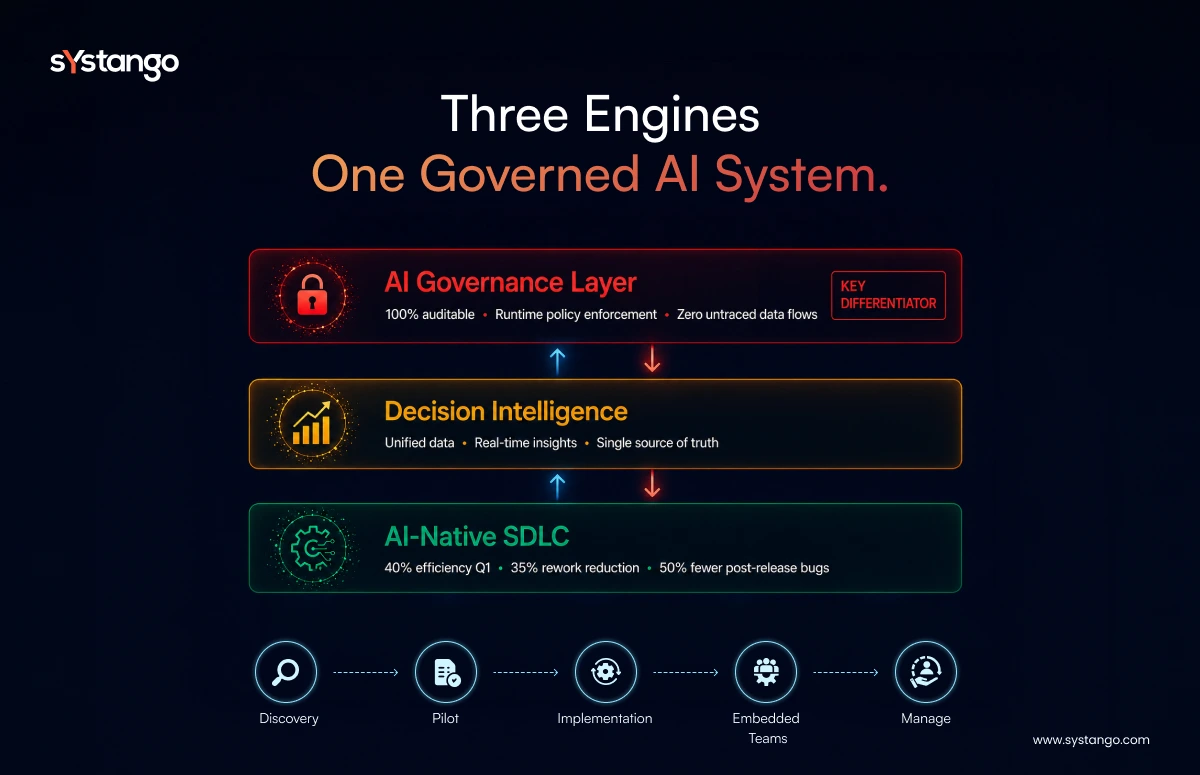
4. Where AI Workbench Delivers Inside FinTech
Expected Business Outcomes The Metrics That Matter to Your Board
Every Systango AI Workbench engagement is tracked against committed baseline metrics. These are documented delivery results not projections.

Beyond engineering: faster sprint cycles mean new products reach customers 30–50% faster than ungoverned AI teams, as McKinsey’s analysis indicates. Built-in audit trails reduce FCA / OCC review cycle time by up to 40%. Systango clients demonstrate board-level AI ROI within 90 days of AI Workbench deployment.
5. Why the Window to Act Is Narrowing in 2026
The compounding nature of AI governance creates a structural first-mover advantage that is increasingly hard to close. Every sprint your competitors run through a governance-first AI system produces cleaner outputs than the last. McKinsey’s analysis indicates that firms falling 18+ months behind the AI governance curve face a structural competitive disadvantage that takes 3–5 years to close.
6. Two external forces are making 2026 the critical inflexion point.
1. FCA’s AI & Advanced Analytics guidance (2025) – The FCA’s supervisory expectations for AI governance are now explicit. Firms without documented AI governance frameworks face increasing scrutiny in their next SYSC review cycle. The grace period for ungoverned AI adoption has closed.
2. LLM commoditisation cliff (2026) – By late 2026, competitive differentiation will not come from which LLM you use, but from how well your engineering system governs, orchestrates, and measures AI across the SDLC. That system takes time to build – and your competitors started building theirs.
7. Three Actions You Can Take This Week
Action 1 – Count your active AI tools. More than four AI tools with no shared prompt standards = a sprawl problem. The AI Chaos Tax Calculator quantifies the cost in one afternoon.
Action 2 – Pull your last three sprint retrospectives. For each rework ticket, ask: Was AI involvement documented? If the answer is ‘no’ or ‘sometimes,’ your compliance review queue is absorbing unnecessary overhead.
Action 3 – Ask your most senior engineer for your current PR merge time. More than two days a review bottleneck that structured AI governance can cut by 40–60%. Multiply by sprint velocity and annual engineering cost – that is your recoverable AI chaos tax.
About Systango
Systango is a publicly listed AI-native digital engineering company. We build governance-first AI systems for regulated FinTech, WealthTech, and InsurTech organisations in the UK and the US. From funded startups to enterprises including Google and Cisco, we are our customers’ technology partner – AI-native by design, governance-first by principle, outcome-accountable by default. Our CEO was one of the youngest VPs of Engineering at Goldman Sachs globally.