

Why Most Blockchain Projects Fail - And What Enterprise Blockchain Development Requires
Last Updated on: August 7, 2026
At a Glance
- What this covers: The six core enterprise blockchain development services, what blockchain consulting actually involves, five engineering decisions that determine production outcomes, and what to demand from any blockchain development company.
- Key finding: Most blockchain projects fail because the team that built the PoC was optimised for speed of demonstration, not for the security, scalability, and governance required to take a system live at scale.
- Business impact: A single exploit on an unaudited smart contract can drain all funds permanently. Unlike software bugs, blockchain errors cannot be patched - they require full redeployment. Protocol design errors in DeFi compound this further: they are irreversible by design.
- What you will learn: The six services that define production blockchain capability, three questions any blockchain consulting engagement must answer, how long a production engagement typically takes, and five decisions that determine whether a blockchain system reaches production.
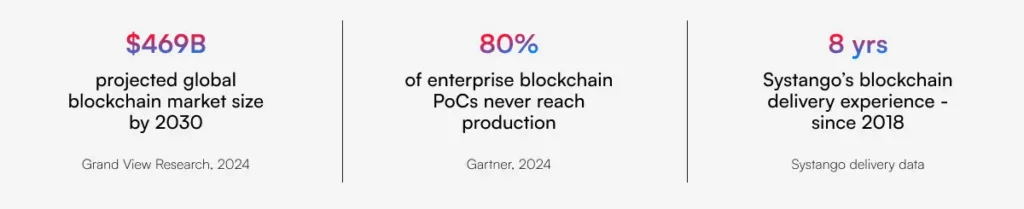
- About this guide: Informed by Systango’s enterprise blockchain delivery experience since 2018 - among the earliest blockchain development company UK engagements focused on production enterprise systems.
Enterprise blockchain development is the engineering discipline of building distributed ledger systems that operate reliably in production - covering smart contracts, decentralised applications, DeFi protocols, and the security and governance infrastructure that determines whether a blockchain initiative survives contact with the real world.
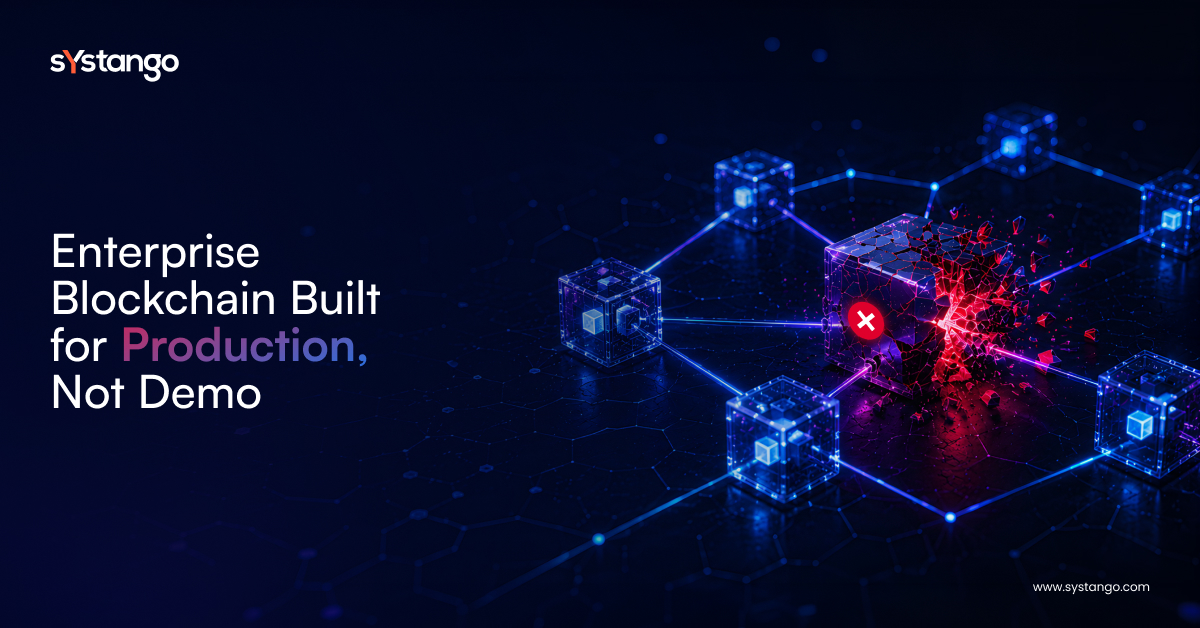
Most blockchain projects fail before they reach production. The PoC team optimised for what would impress in a demo. The production team inherits what cannot be patched, migrated, or retrofitted - protocol design errors are irreversible, unaudited smart contracts are attack surfaces, and chain selection mistakes require full rebuilds. In 2026, as enterprise blockchain converges with AI governance and tokenised asset infrastructure, the engineering gap between a PoC and a production system is wider than ever.
This guide covers the six core blockchain software development services that determine production outcomes, what genuine blockchain consulting involves, and what separates a credible blockchain development company UK from the rest. Part of Systango’s Blockchain & Digital Assets services guide.
I. The six core enterprise blockchain development services
A credible enterprise blockchain development partner covers six connected capabilities - each with a specific production consequence if skipped:
Web3 and blockchain discovery: strategy-first engagement before any code is written. Use case validation, feasibility assessment, platform selection (Ethereum, Solana, Hyperledger, Polygon), and architecture design. The single most important investment a blockchain development company can recommend - and the one most organisations skip because it does not feel like progress.
Smart contract development: the logic layer of every blockchain application. Smart contracts must be written for correctness, gas efficiency, and upgradeability - and audited by an independent security firm before any funds or data are committed. A blockchain software development company that ships unaudited smart contracts is shipping a liability, not a product.
Decentralised application (dApp) development: the front-end and integration layer connecting users to on-chain logic. Production dApps require performant frontends, wallet integration, and the AI-powered features users now expect from web3 development services.
DeFi platform development: decentralised exchange architecture, liquidity infrastructure, AI trade execution, and the compliance layer regulated DeFi platforms require in 2026. Blockchain app development for DeFi is among the most technically complex in the ecosystem - protocol design errors are irreversible.
NFT and digital asset ecosystems: marketplace architecture, NFT contract standards (ERC-721, ERC-1155), royalty mechanics, and custom marketplace builds. Requires equal attention to the smart contract layer, marketplace UX, and gas optimisation that determines economic viability.
Blockchain wallet development: custodial, non-custodial, and MPC wallet architecture with multi-chain support, HSM security, and Fireblocks implementation for institutional-grade custody. Security compromises in the wallet layer are not recoverable - there is no patch for a custody breach.
II. What blockchain consulting services actually involve
Blockchain consulting services are the most misunderstood category in the Web3 ecosystem. Most organisations expect platform recommendations and a technology roadmap. What they actually need is a commercially rigorous assessment of whether blockchain is the right solution for their specific problem. Three questions any credible blockchain consulting engagement must answer before development begins:
- Does this problem actually require a blockchain? Blockchain adds latency, complexity, and cost compared to a centralised database. The most valuable output of a blockchain consulting engagement is sometimes the recommendation not to build - saving months of development cost on a solution that would never reach production.
- Which chain architecture is right? Public chains (Ethereum, Solana, Polygon) offer decentralisation and composability. Private blockchain development on permissioned chains (Hyperledger Fabric, R3 Corda) offers governance and compliance control. The choice must be made at the architecture stage, not the deployment stage.
- How does governance, compliance, and security work from day one? Smart contract security audits, key management architecture, and regulatory compliance (FCA, SEC, MiCA) are not post-launch considerations. See our AI Governance Layer for how Systango approaches governance design across complex technology systems. A blockchain software development company that treats security as a final phase is building technical debt into the foundation.
What this looks like when governance is done correctly
A digital music rights company needed to register, trace, and automate royalty distribution for creative IP across multiple parties - with verifiable ownership and zero manual reconciliation.
- Every governance decision - royalty split logic, dispute resolution, upgrade patterns - was made before a single contract was deployed.
- Systango designed and deployed the full system: ISCC-backed content registration, automated multi-party royalty distribution, and a production-ready mainnet infrastructure. 55+ smart contracts deployed, 100% IP traceability across all registered assets, royalties automated with zero manual reconciliation, mainnet live for production launch.
- Changing any governance decision after deployment would have required redeploying all 55+ contracts. Front-loading governance is not caution. It is the only viable approach.
If the first meeting with a blockchain consultant jumps to technology stack selection, the engagement is optimised for billing, not outcomes.
III. Five engineering decisions that determine enterprise blockchain outcomes
These decisions must be made before the first line of code is written. Getting any of them wrong after deployment requires a full rebuild:
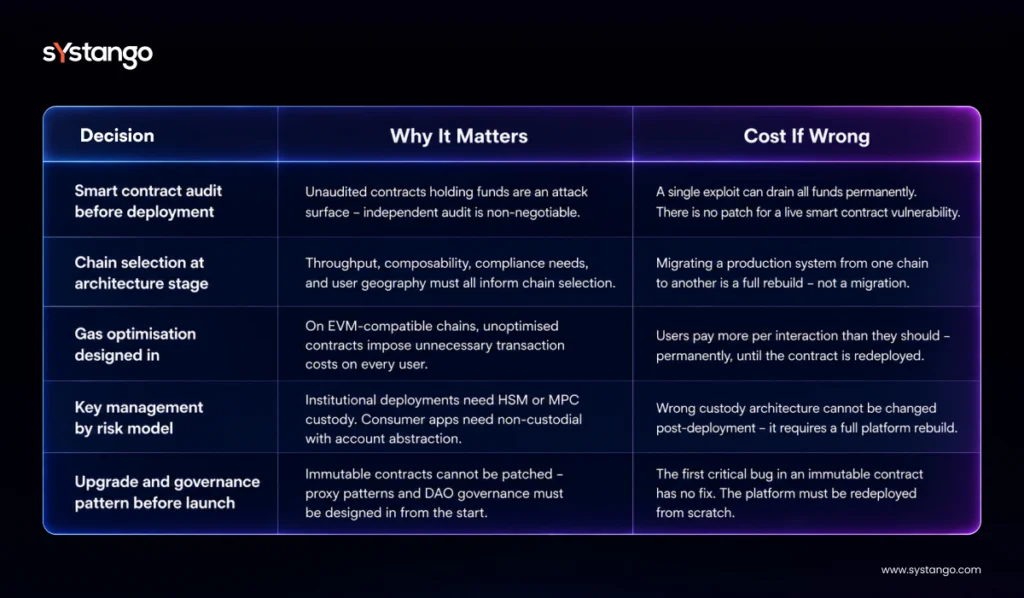
Take this to your next architecture review: every row in this table is a decision your team should be able to name an answer for before development starts. A “we’ll decide during the build” answer to any row is the retrofit risk described throughout this guide.
Key Takeaways
- The strongest predictor of whether a blockchain engagement will reach production is whether the first meeting focuses on “do we need this” or jumps straight to technology stack selection.
- The strongest signal of a credible blockchain consulting engagement is a willingness to recommend against building entirely.
- A smart contract holding funds without an independent security audit is not a calculated risk - it is a date with an inevitable exploit.
- Chain selection made at deployment stage, not architecture stage, requires a full rebuild to correct.
- Security, compliance, and governance must be designed in from discovery - retrofitting costs significantly more.
As a blockchain engineering partner, we’ve been delivering enterprise blockchain solutions since 2018, with every engagement beginning with a discovery sprint before any code is written, every smart contract engagement including independent security auditing, and every deployment structured around a governance framework appropriate to the chain and compliance environment involved. Explore our Blockchain & Digital Assets services and AI Governance Layer to understand how we approach your specific challenge.