

AI Development Services: Why the Gap Between PoC and Production Is an Engineering Problem
Last Updated on: June 4, 2026
Key Takeaways
I. The PoC-to-production gap: what actually causes it
II. The five capabilities of enterprise AI development services
III. Four engineering decisions that determine production AI outcomes
IV. What to demand from an AI development company
V. Why Systango for AI and machine learning development
Most enterprise AI projects follow the same arc. A proof-of-concept gets approved. A pilot runs. Leadership sees a demo. Then the project stalls – not because the idea was wrong, but because nobody planned for the engineering required to take it beyond the demo environment.
This is the defining challenge of enterprise AI in 2026. The question is no longer whether to invest in AI. It is why so many AI investments sit between PoC and production – and what it takes to close that gap.
This guide covers the five core AI development services that determine production outcomes, the engineering decisions that most companies get wrong, and what to look for in a genuine AI development company. Each section links to a deeper cluster blog.
I. The PoC-to-production gap: what actually causes it
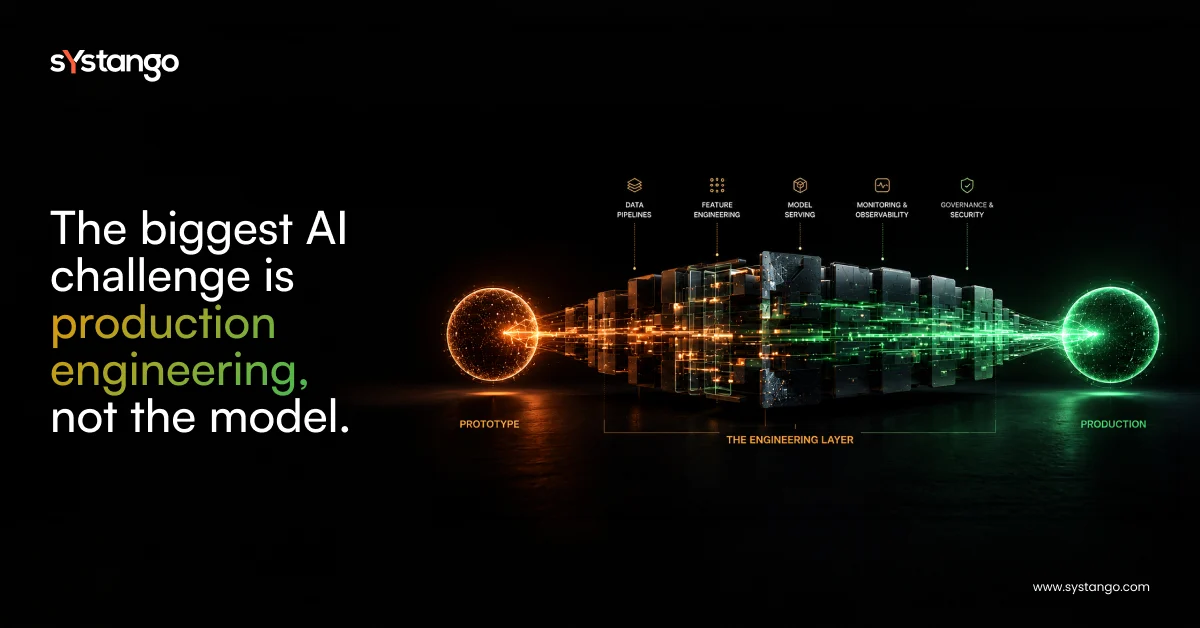
A PoC is built to prove an idea works. A production system is built to work reliably, at scale, under real-world conditions, with governance and observability in place.
These are fundamentally different engineering problems – and most AI software development engagements that fail do so because the team that built the PoC was not thinking about the second problem at all.

The patterns are consistent across industries:
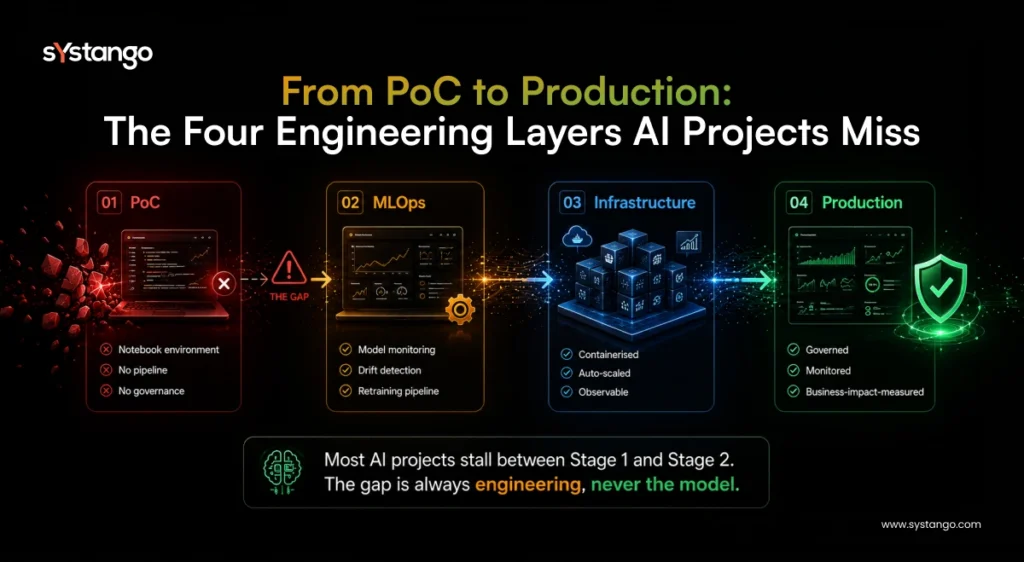
- Training-serving skew: the model behaves differently in production than it did in the PoC because the data pipeline in production is not identical to the training pipeline. A gap that is invisible in demos and catastrophic in live systems.
- Missing MLOps: no model monitoring, no drift detection, no retraining pipeline. The model degrades silently after deployment and nobody notices until a business metric moves.
- Governance retrofitted: compliance, audit trails, and access controls were not designed in from the start. In regulated industries – FinTech, InsurTech, Legal Tech – this alone can block a deployment.
- Infrastructure mismatch: the PoC ran on a data scientist’s machine or a notebook environment. Production requires containerised, monitored, auto-scaled infrastructure that was never part of the original scope.
Closing the PoC-to-production gap requires AI/ML development services that treat production engineering as a first-class deliverable – not a phase two conversation.
II. The five capabilities of enterprise AI development services
A. Generative AI and large language models
Generative AI development in production means more than calling an API. It means designing retrieval-augmented generation (RAG) pipelines that ground model outputs in your proprietary data, implementing agentic workflows where models plan and execute multi-step tasks autonomously, and establishing guardrails that prevent outputs from causing compliance or reputational exposure. The GenAI layer is only as reliable as the data and orchestration infrastructure beneath it.
B. Custom AI and intelligent automation
Domain-specific problems require domain-specific models. A machine learning development company builds models trained on your data, for your decision context – not generic solutions adapted after the fact. Whether the use case is document intelligence, anomaly detection, process automation, or conversational AI, the model architecture, training data, and integration layer must be purpose-designed.
C. Predictive analytics and ML
Forecasting, classification, and risk scoring models deliver value only when they are embedded directly into operational workflows – not sitting in a BI dashboard. AI ML development services at production grade include feature engineering pipelines, model versioning, A/B testing infrastructure, and the MLOps layer that keeps predictions accurate as underlying data distributions shift.
D. Agentic AI systems
The shift from generative AI to agentic AI is the most consequential trend in enterprise AI software development services in 2026. Agents do not just generate outputs – they plan, reason across steps, call external tools, and execute workflows autonomously. Building production-grade agentic systems requires multi-agent orchestration design, tool use frameworks (MCP, function calling), memory architecture, and robust human-in-the-loop governance to prevent runaway autonomous actions.
E. AI strategy and transformation consulting
The most expensive AI failure is the one that gets built. A credible artificial intelligence development company runs a data readiness and use case prioritisation assessment before any model is designed. This means evaluating which AI use cases have the data, the ROI case, and the organisational readiness to reach production – and sequencing investment accordingly.
III. Four engineering decisions that determine production AI outcomes
The AI development services market is crowded. These are the decisions that separate vendors who deliver demos from partners who deliver production systems:
- MLOps as standard, not optional: model monitoring, drift detection, automated retraining, and model versioning must be part of every AI delivery. A generative AI development company that does not include MLOps in its standard delivery model is building you a PoC, not a product.
- Agentic architecture readiness: as enterprise AI moves from single-model inference to multi-agent orchestration, the underlying infrastructure must support agent-to-agent communication, tool registries, and memory persistence. Design decisions made at PoC stage are expensive to unwind.
- Governance and observability by default: every model output must be traceable. In regulated industries, this is a compliance requirement. In unregulated industries, it is a risk management requirement. Governance retrofitted after deployment costs significantly more than governance designed from day one.
- Data pipeline parity: the data pipeline in production must mirror the pipeline used for training. Training-serving skew is one of the most common and most invisible causes of production AI underperformance. An AI ML development company that does not enforce pipeline parity between training and serving environments will deliver a model that works in the demo and degrades in the field.
IV. What to demand from an AI development company
Evaluating AI software development services vendors requires going beyond case studies and technology logos. The questions that matter:
- Does the provider include MLOps, monitoring, and retraining as standard deliverables – or as paid add-ons?
- Can they demonstrate production AI deployments with measurable business outcomes – not just working prototypes?
- Do they design for governance and compliance from discovery, not as a post-launch consideration?
- Do they hold active cloud AI certifications – AWS, GCP, or Azure ML – with named engineers, not just partnership logos?
- Is their delivery framework structured to reduce PoC-to-production risk, or optimised to start billing quickly?
The best AI development company engagements are not scoped as model delivery projects. They are scoped as production capability builds – with defined success metrics, governance frameworks, and ongoing MLOps ownership from day one.
V. Why Systango for AI and machine learning development
Systango’s AI/ML development services follow a four-phase production-first delivery framework: Discover & Prioritise, Prototype & Validate, Deploy & Enable, and Scale & Optimise. Every phase is designed to close the PoC-to-production gap – not to extend it.
As a publicly listed artificial intelligence development company with 18 years of enterprise delivery – ISO 27001 certified, AWS Advanced Partner, and top 20 globally for Google’s Generative AI Services Specialisation – Systango builds AI systems that reach production and stay there. Our AI Workbench delivers 40% faster development cycles and 35% reduction in post-release rework across AI and ML engagements.
Explore our AI Engineering & MLOps services to understand how we approach your specific AI development services challenge.