

Why InsurTech AI pilots succeed and production deployments fail: the SDLC gap nobody talks about
Last Updated on: May 14, 2026
Key Takeaways
I. Why InsurTech AI pilots succeed and production deployments fail
II. Three failure patterns behind the InsurTech AI production gap
III. What production-ready InsurTech AI delivery looks like
IV. Where AI Workbench delivers in InsurTech AI deployment
V. Expected outcomes – InsurTech AI that reaches production
VI. Why the InsurTech AI production window is narrowing in 2026
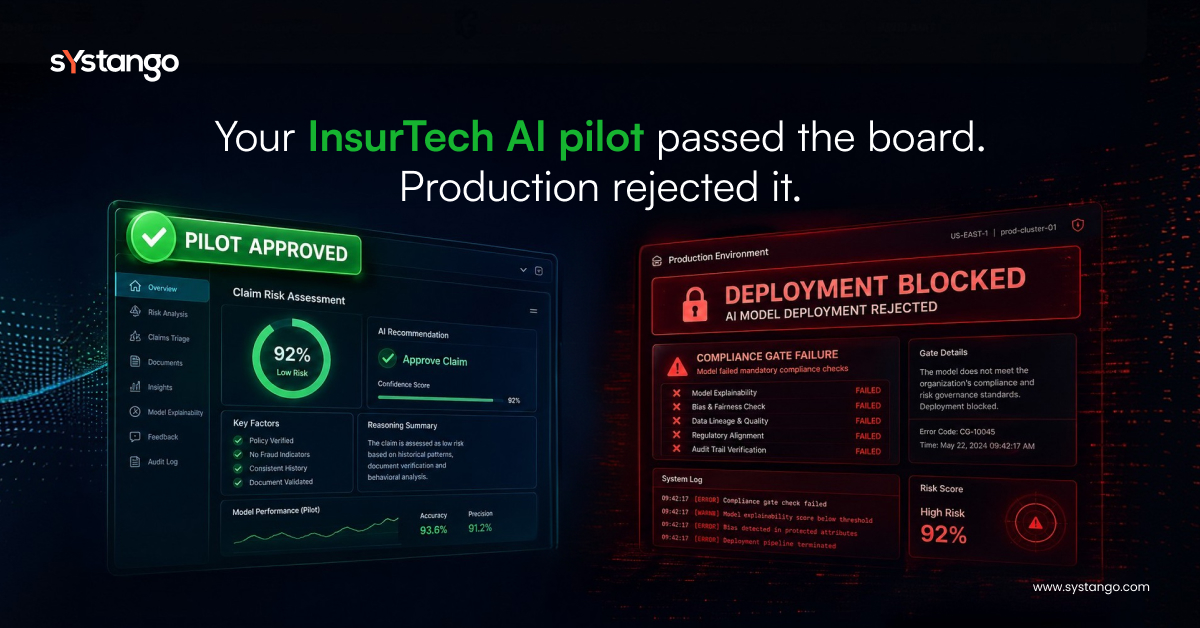
The InsurTech AI adoption story is the same across markets: the pilot impresses, the board approves, and then the deployment fails. Not because the model was wrong. Because the production environment – the live policy admin system, the claims workflow, the regulatory audit trail – was never designed to host it. The AI SDLC framework that produced the pilot and the infrastructure that must host the deployment are two different things.
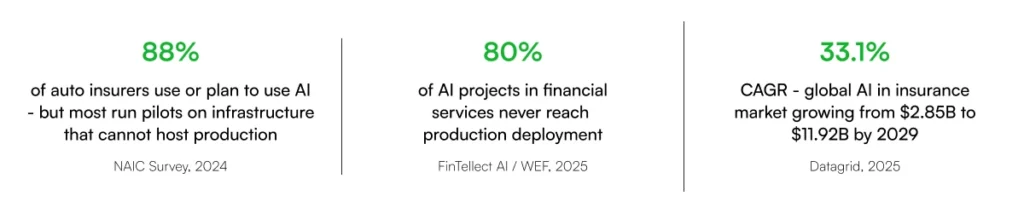
NAIC’s 2024 survey found 88% of auto insurers using or planning to use AI. What the survey did not measure is how many are running those AI systems in production with the governance documentation the NAIC Model AI Bulletin, FCA Consumer Duty, and GDPR Article 22 require. The gap between those two numbers is where AI deployment challenges live.
I. Why InsurTech AI pilots succeed and production deployments fail
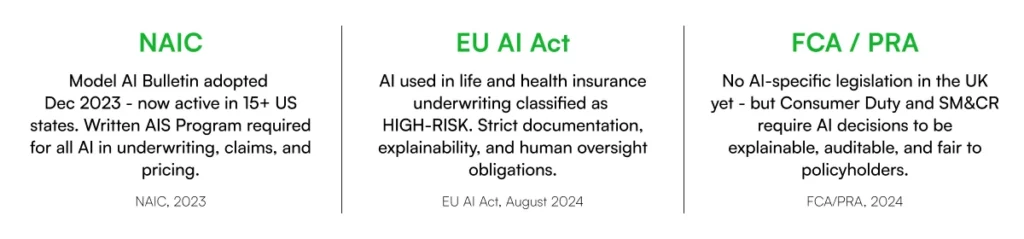
FinTellect AI’s research, published with the World Economic Forum, found 80% of AI projects in financial services fail to reach production. In InsurTech, the blockers are structural: policy admin systems built on batch architecture cannot ingest AI inference outputs in real time; NAIC’s AIS Program mandates governance documentation the pilot never generated; and the EU AI Act classifies AI in life and health insurance underwriting as high-risk, requiring training data documentation, bias testing, and human oversight mechanisms before deployment. A pilot that succeeds without a governance-first AI layer in the SDLC will fail the production gate.
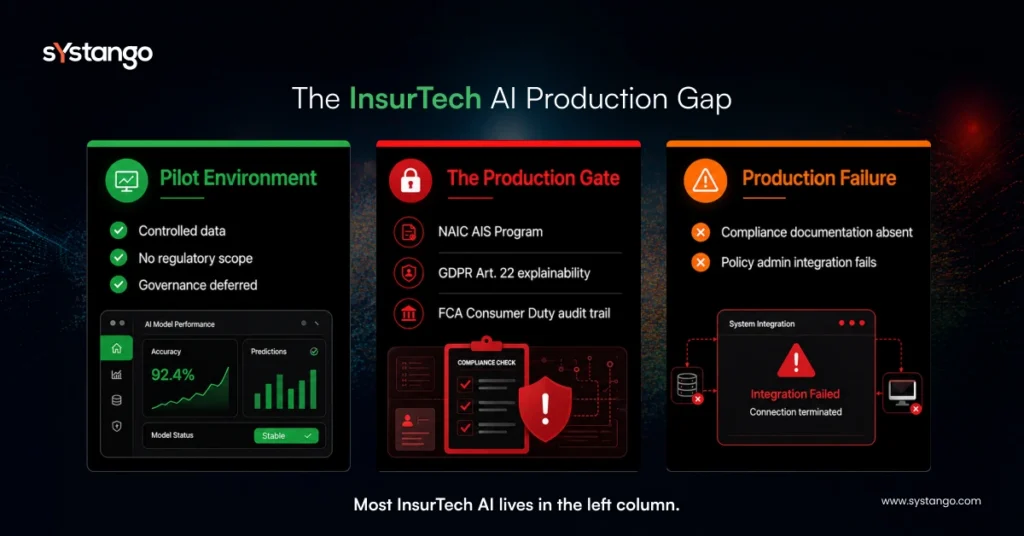
II. Three failure patterns behind the InsurTech AI production gap
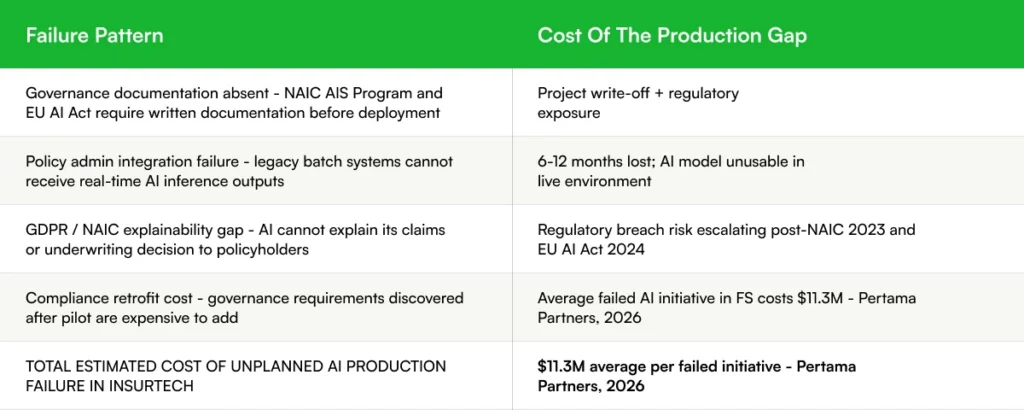
Gap 1 – The governance documentation gap: NAIC and EU AI Act require evidence before deployment
NAIC’s Model AI Bulletin requires a written AIS Program covering governance, risk management, documentation, and bias testing across the full AI lifecycle. The EU AI Act requires high-risk insurance AI to document training data, algorithmic logic, and bias testing before deployment. Pilots built without these requirements produce models that cannot be deployed under current regulatory expectations.
Gap 2 – The integration gap: policy admin systems were not designed for AI inference
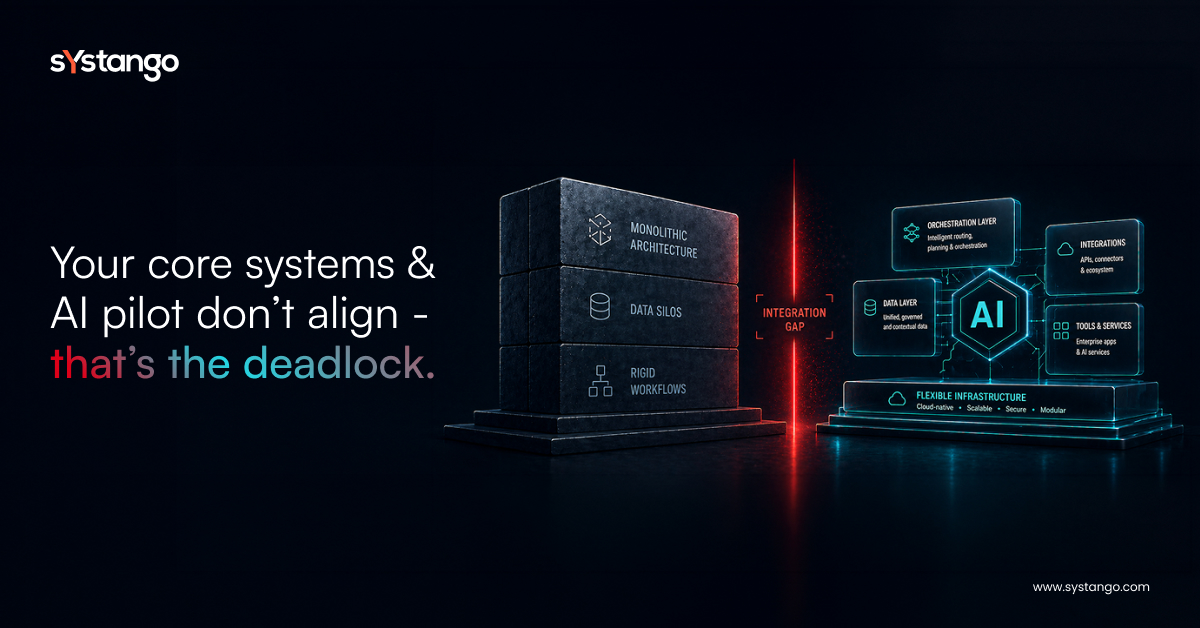
Most InsurTech policy admin systems were built for batch processing: overnight reconciliation, periodic model re-scoring, manual queues. AI inference requires real-time data ingestion, sub-second API response, and continuous audit trail generation. The AI deployment challenges that kill production deployments are not about the model – they are about the infrastructure it must connect to.
Gap 3 – The explainability gap: GDPR Article 22 and NAIC require decisions the AI cannot reconstruct
GDPR Article 22 gives policyholders the right to an explanation of automated decisions significantly affecting them – including claims triage and underwriting. NAIC’s AIS Program requires bias documentation and audit-ready outputs for adverse decisions. This documentation cannot be added after the model runs. It must be generated at the point of decision.

III. What production-ready InsurTech AI delivery looks like
1. Governance built into the SDLC – not bolted on after the pilot
Platforms that meet NAIC AIS Program requirements treat bias testing, audit trail generation, and explainability documentation as engineering deliverables in the CI/CD pipeline – not a post-build review stage. The AI-native SDLC makes NAIC and EU AI Act compliance a byproduct of how the model is built.
2. Policy admin integration designed before the AI model is scoped
The correct build sequence: API modernisation and real-time data layer first, governance framework second, AI model third. Platforms that invert this produce pilots that cannot deploy. Based on Systango’s delivery data, clients achieve zero-downtime production migrations when the integration layer is resolved before the model is scoped.
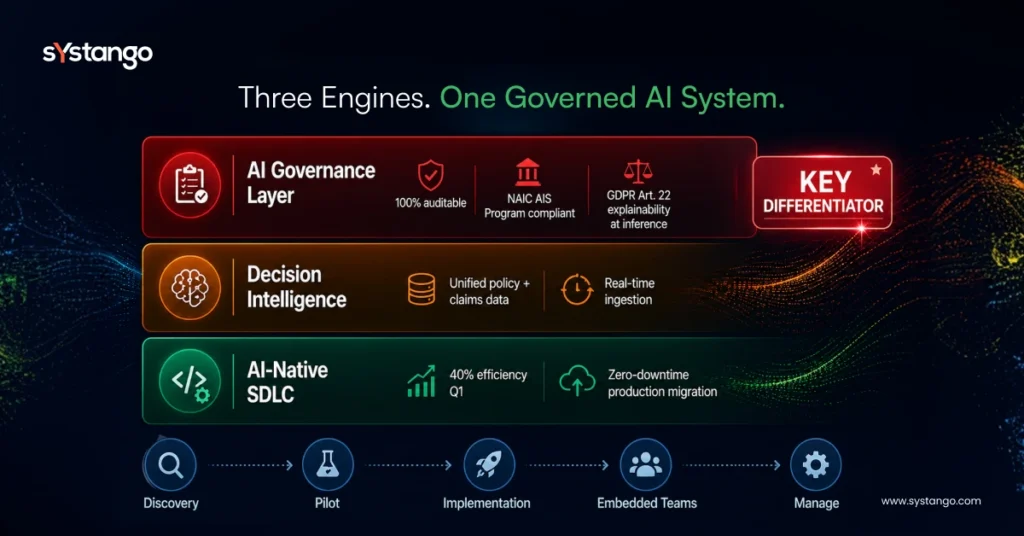
IV. Where AI Workbench delivers in InsurTech AI deployment
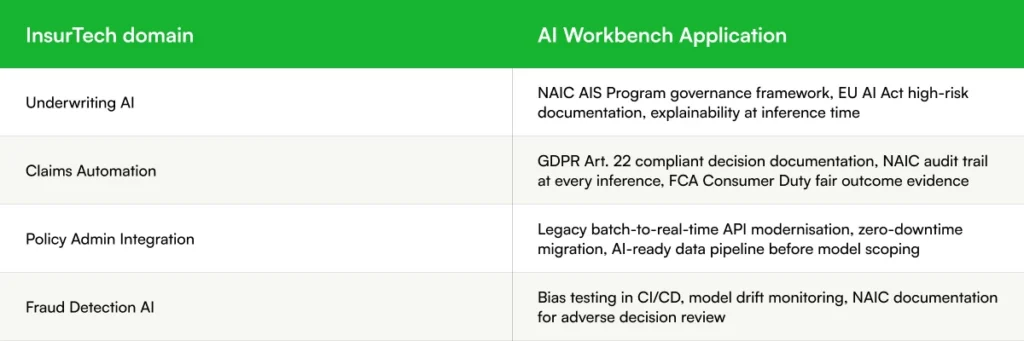
V. Expected outcomes – InsurTech AI that reaches production
Documented delivery results from live AI Workbench engagements – not projections.

VI. Why the InsurTech AI production window is narrowing in 2026
The NAIC Model AI Bulletin is active in 15+ US states and the EU AI Act’s high-risk provisions for insurance underwriting AI are fully applicable from August 2026. Every InsurTech AI initiative built without a governance layer now is more likely to fail the 2026 regulatory production gate than the 2024 one. The compliance gap between a pilot that works and a deployment that is AIS Program-compliant is widening every quarter.
Three checks before your next InsurTech AI deployment
1. Does your AI model generate NAIC-compliant governance documentation – bias testing, model lifecycle records, adverse decision audit trail – at inference time?
If the answer is ‘we can add that later,’ later is after the regulatory gate.
2. Can your policy admin system receive real-time AI inference outputs via API at production volume? Test against sub-300ms response time. If it cannot meet this threshold, the AI model is designed for infrastructure that does not yet exist in production.
3. Can your AI model produce a GDPR Article 22 explanation for a specific claims or underwriting decision, on demand?
If not, every automated decision affecting a policyholder in the EU or UK is a subject access request you cannot answer.
About Systango
Systango is a publicly listed AI-native digital engineering company. We build governance-first AI systems for regulated FinTech, WealthTech, and InsurTech organisations in the UK and US. From funded startups to enterprises including Google and Cisco, we are our customers’ technology partner – AI-native by design, governance-first by principle, outcome-accountable by default.