

How to Choose an AI Development Company UK: The 2026 Shortlisting Guide
Last Updated on: August 11, 2026
At a Glance
- What this covers: How to distinguish a genuine AI engineering company UK from an AI-washed agency, six capabilities your partner must have in 2026, UK-specific factors most buyers miss, and ten questions to ask before signing.
- Key finding: The number of UK companies calling themselves AI development agencies has tripled in 18 months. Most are API integrators, not AI engineering companies. The difference costs six months and a significant budget if missed at the shortlisting stage.
- Business impact: A failed AI vendor engagement costs more than the contract value - in delayed delivery, re-scoping costs, and the competitive lag that accumulates while the rebuild happens. Getting the selection right is the most commercially important decision in the process.
- What you will learn: The three signals that separate real AI engineering from AI-washing, UK-specific compliance factors most buyers overlook, and the ten questions that surface production capability faster than any RFP.
- About this guide: Written by Systango - a publicly listed, ISO 27001 certified AI engineering company with 18 years of UK enterprise delivery and 700+ production digital products shipped.
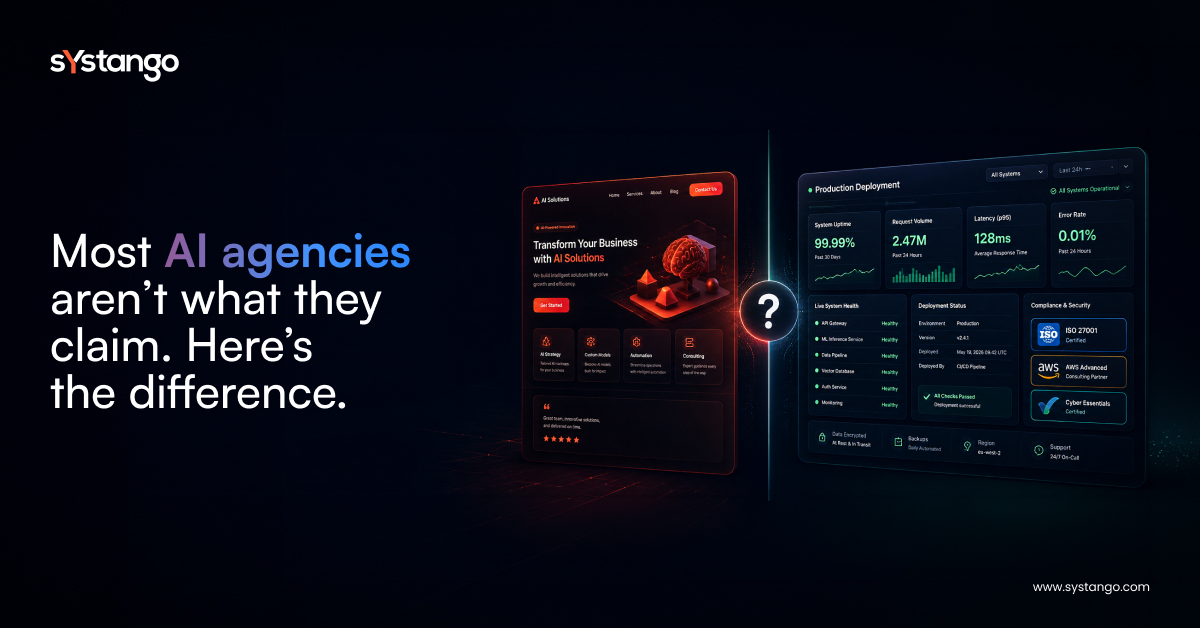
Knowing how to choose an AI development company in the UK has never been more difficult - or more consequential. The number of UK companies calling themselves AI development agencies has tripled in 18 months. Most of them are API integrators presenting third-party wrappers as bespoke AI engineering. Knowing the difference before you sign is the most commercially important decision in your digital transformation.

This guide gives decision makers the signals, questions, and UK-specific factors needed to shortlist correctly. The checklist is at the bottom. Read the guide first.
I. Real AI engineering vs AI-washing: how to tell the difference
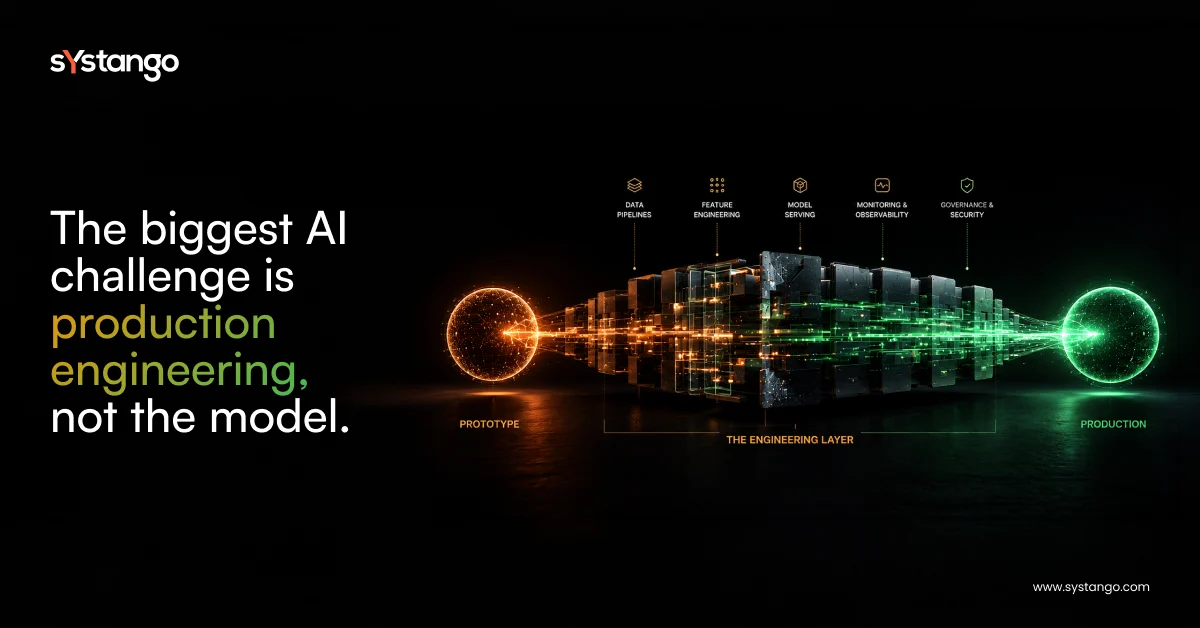
The term ‘AI-washed’ describes agencies that have rebranded existing software services as AI without genuine machine learning engineering capability. In practice: they integrate OpenAI or a similar API and present it as bespoke AI development. The cost difference between API integration and genuine model engineering is significant. The risk difference is larger.
Three signals of a genuine AI engineering company UK:
- They build models, not just integrate APIs. A genuine partner explains the difference between fine-tuning a foundation model, building a RAG pipeline, and wrapping an API. “We use the OpenAI API” is an integration answer, not an engineering answer.
- They have MLOps infrastructure. Production AI requires model monitoring, drift detection, and retraining pipelines. Any AI development partner UK without a functioning MLOps practice has not taken a model to production at scale.
- They raise data governance unprompted. A genuine AI engineering company asks about your data sources, UK GDPR obligations, and data minimisation approach before any model is scoped - not after you raise it.

What we typically see in shortlisting conversations
Across the vendor evaluations we’re part of, the same patterns separate real capability from a good pitch:
- A vendor who answers “how do you handle drift” with a specific process (thresholds, retraining triggers, who gets alerted) is describing something they’ve actually run in production. A vendor who answers with “we monitor performance” and stops there is describing an intention, not a system.
- Genuine partners ask uncomfortable scoping questions early - “is this the right use case,” “is your data actually ready” - because saying no to a bad-fit engagement costs them less than a failed delivery does. Agencies optimising for signing tend to say yes to everything in the first meeting.
- The compliance conversation is a good proxy for the technical conversation. A vendor who raises UK GDPR and data minimisation unprompted has usually also thought seriously about drift, versioning, and rollback - the two disciplines tend to travel together.
II. Six capabilities your AI development partner UK must have in 2026
An agency missing more than one of these is not equipped for production deployment:

III. UK-specific factors most buyers miss
- UK GDPR and Article 22: if your AI system processes personal data, your partner must understand lawful basis, data minimisation, and Article 22 - the right not to be subject to solely automated decisions. Applies to credit scoring, hiring tools, and customer onboarding. A partner who cannot speak to this unprompted has not built compliant AI for UK enterprise.
- FCA considerations: any AI system touching financial decisions sits within the FCA’s supervisory perimeter and requires explainability, auditability, and ongoing monitoring. Your AI development partner UK must have direct FCA engagement experience.
- IR35 and contractor team risk: some AI agencies are contractor networks, not employed engineering teams. If HMRC determines your engagement falls inside IR35, liability can fall on your business. Ask what proportion of the delivery team are employees.
- Listed vs private company accountability: a publicly listed AI engineering company UK has legal obligations around financial transparency that private agencies do not. For enterprise supplier due diligence, this distinction matters.
IV. Ten questions that surface production capability faster than any RFP

In Practice
A safety-critical engineering company shortlisted three AI development partners. Two presented polished decks and proposed starting development within two weeks. The third asked to run a Discovery engagement first - data readiness assessment, use case validation, governance framework design.
The first two were offering to build before knowing what to build. Systango ran the Discovery. What followed: AI tooling embedded across the SDLC, production-grade governance, and measurable delivery outcomes within the first quarter.
Outcome: 90% faster compliance reporting, 50% faster feature delivery, 100% of AI interactions auditable on demand.
Lesson from this engagement: the partner who wants to start building immediately is optimising for billing. The partner who insists on Discovery first is optimising for outcomes. That difference is visible in week one.
Key Takeaways
- The number of UK companies calling themselves AI development agencies has tripled in 18 months - most are API integrators, and the shortlisting stage is where that difference gets caught or missed.
- ISO 27001 (UKAS-accredited), employed engineering teams, and MLOps in production are the minimum bars - not differentiators.
- UK GDPR Article 22, FCA compliance experience, and IR35 structure are the three UK-specific factors most buyers miss.
- The partner who pushes to start building before Discovery is optimising for billing. The one who insists on Discovery first is optimising for outcomes.
- A Discovery engagement (£8,000-£15,000) is the most commercially efficient way to validate a production AI partner before committing budget.
As an AI engineering company UK, Systango runs every engagement through a structured Discovery sprint first - a validated use case, a data readiness assessment, and a production pathway, before any build is committed. Systango is publicly listed, ISO 27001 certified, an AWS Advanced Partner, and ranks top 20 globally for Google’s Generative AI Services Specialisation, with 18 years of enterprise delivery and 700+ production digital products shipped. These credentials are what back the Discovery-first approach described throughout this guide, not a separate claim to trust. Explore our AI Engineering & MLOps services, AI Governance Layer, and AI Readiness Assessment.