Why Lift-and-Shift Migrations Fail - And What Cloud Migration Services Actually Fix
Last Updated on: August 12, 2026
At a Glance
- What this covers: The five disciplines of cloud infrastructure services, four patterns that determine migration outcomes, when NOT to migrate, and what to demand from any cloud infrastructure consulting provider.
- Key finding: Enterprises that budget only for the lift consistently discover mid-migration that the real cost is the re-architecture they skipped - at the worst possible moment to make that discovery.
- Business impact: Teams that invest in replatforming rather than lifting and shifting achieve 30-40% lower cloud operating costs within 12 months. The savings are in the architecture decisions made before migration begins.
- What you will learn: The five cloud service disciplines with their business risks, the four migration patterns that separate outcomes from overspend, and the self-assessment questions to ask before committing to cloud.
- About this guide: Informed by Systango’s experience delivering cloud infrastructure services across AWS, Google Cloud, and Azure for enterprise clients in FinTech, WealthTech, and regulated industries
Cloud migration services are the engineering discipline of moving workloads, data, and applications from legacy or on-premise environments to a target cloud architecture - with the governance, cost model, and operational framework required to make that infrastructure perform reliably after go-live.
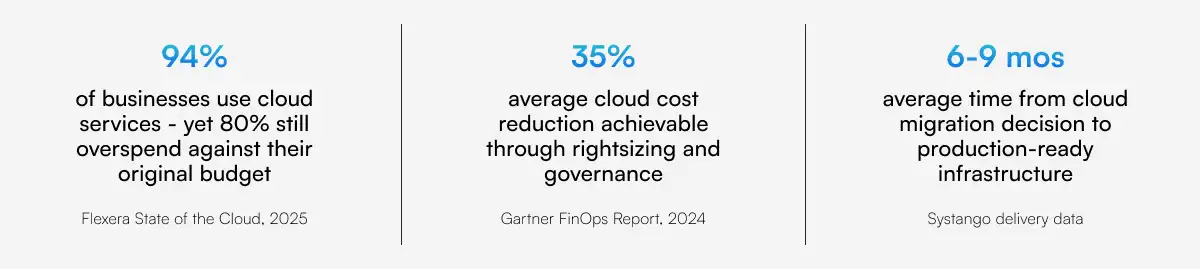
The pattern is consistent across industries: an organisation budgets for the lift, moves workloads into a cloud environment, and discovers six months later that cloud spend has increased without a corresponding improvement in performance, resilience, or agility. The legacy architecture came with them. In most cases, the organisation had not changed what was wrong - it had just moved it somewhere more expensive to run.
This guide covers the five disciplines of cloud infrastructure management services, the four patterns that determine migration outcomes, and what separates cloud infrastructure consulting that delivers long-term value from the kind that creates a new category of technical debt. Part of Systango’s Cloud Engineering & Infrastructure services guide.
I. The five disciplines of cloud infrastructure services
A credible cloud infrastructure engagement covers five connected capabilities. Each has a direct business consequence if skipped:
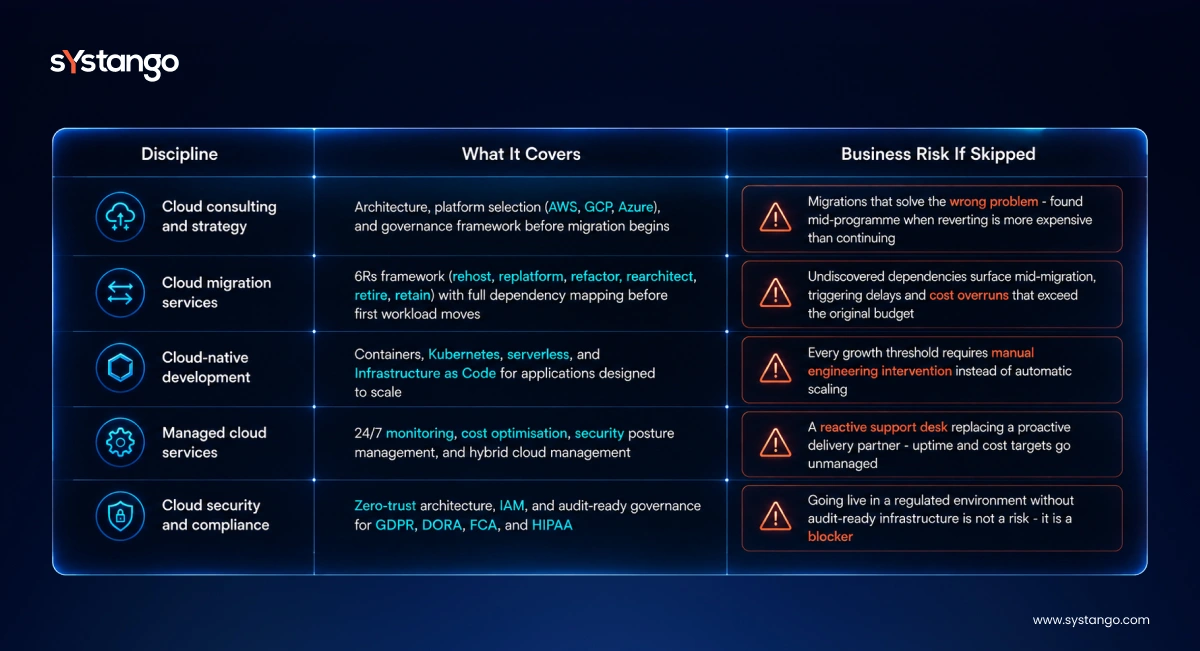
See our Cloud Migration Services guide for the full 6Rs framework, and our Managed Cloud Services guide for what a genuine managed engagement covers versus a support desk.
Why this matters for you: these five disciplines aren’t sequential phases you can defer - strategy, migration, and security decisions interact. Choosing a target architecture (discipline one) without accounting for compliance requirements (discipline five) is exactly how organisations end up re-architecting mid-migration instead of before it.
II. When cloud migration is - and is not - the right decision
Not every organisation is ready to migrate. The decision to move should follow evidence, not momentum:
- Migrate when: infrastructure costs are scaling faster than your business, on-premise expansion requires capital investment you cannot justify, or compliance demands cloud-native security controls your current environment cannot provide.
- Do not migrate yet when: application dependencies are undocumented, your compliance and governance framework is not cloud-ready, or your team lacks the engineering capability to operate the target environment. Moving into unreadiness does not solve the problem - it relocates it.
- The decision factor: if you cannot define your target architecture, compliance requirements, and operational runbook before migration begins - start with a cloud readiness assessment first. The assessment is cheaper than the retrofit.
III. Four patterns that determine cloud migration outcomes
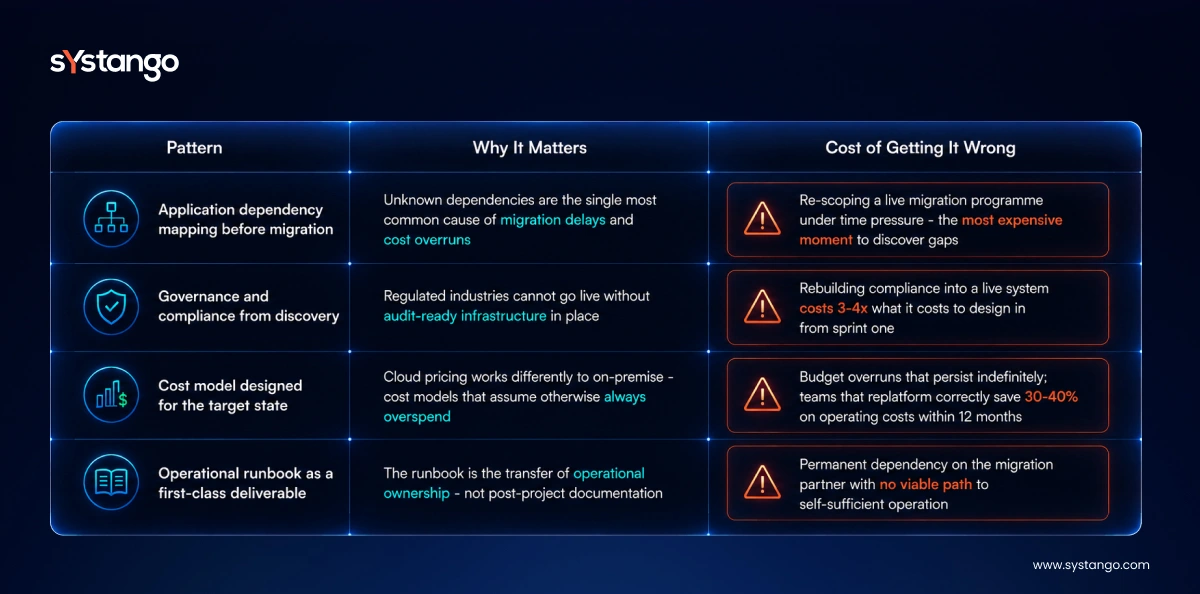
These four patterns are present in every successful migration we have delivered. All four must be in place before the first workload moves:
IV. Hybrid cloud management: designing for complexity
Enterprise organisations rarely end up in hybrid cloud by strategic choice. It accumulates: a legacy system that resists migration, a compliance requirement mandating on-premise data residency, a workload optimised for one specific provider. The result is an environment spanning public cloud, private cloud, and on-premise - with no unified governance layer connecting them.
A mature hybrid cloud management framework changes this. It delivers unified observability across all environments, consistent security and compliance enforcement, FinOps governance that tracks spend per workload across providers, and orchestration that routes workloads to the most cost-effective environment in real time. Without it, the question “where is our cloud spend going?” has no reliable answer.
In Practice
A UK energy-tech platform had been on cloud for years. It was still slow, still expensive, and still batch-processing meter data overnight.
What changed: AWS Lambda replaced legacy PHP scripts, auto-scaling microservices replaced fixed infrastructure, and the cost model was redesigned before a single workload moved.
- 36x faster data throughput
- $54K annual cloud savings
- 40% improvement in app responsiveness
- Infrastructure built for 1 million users
The savings did not come from moving to the cloud. It came from redesigning the cost model before the migration started.
Key Takeaways
- A lift-and-shift approach moves legacy architecture into the cloud - it does not fix it. The debt compounds in a new environment.
- Every undiscovered application dependency is a migration delay waiting to happen. Map them before the first workload moves - not after.
- The operational runbook is the actual transfer of ownership from migration partner to internal team - treating it as post-project documentation is why organisations stay dependent on their partner indefinitely.
- Hybrid cloud managed without a unified governance layer means no reliable answer to where cloud spend is going at any time.
- Compliance built into a live cloud environment costs 3-4x more than compliance designed into the architecture from the start.
As a cloud infrastructure partner,we deliver cloud infrastructure management services across AWS, Google Cloud, and Azure - as an AWS Advanced Partner and Google Cloud Partner, ISO 27001 certified. These credentials back the delivery approach described throughout this guide, not a separate claim to trust. Our four-phase delivery framework - Assess & Design, Migrate & Build, Optimise & Secure, Manage & Scale - is structured to deliver cloud infrastructure that performs from day one and compounds in value over time. Every cloud migration services engagement includes full application dependency mapping, compliance-by-design architecture, FinOps governance from the first sprint, and a complete operational runbook at go-live. Explore our Cloud Engineering & Infrastructure services to know more.