

Why your AI investment isn’t showing up in your fintech delivery metrics and what your board needs to see
Key Takeaways
1. Why task-level gains disappear before they reach your board
2. The measurement gap that makes AI ROI invisible
3. What fintech teams with board-ready AI ROI do differently
4. Where AI Workbench delivers inside fintech
5. Why the board conversation on AI ROI cannot wait until 2027
6. Three calculations to run before your next board meeting
There is a question your board is already asking. It sounds like this: we have been investing in AI tools for eighteen months. Where is it showing up in the numbers? If you cannot answer that with specific, attributable metrics, you do not have an AI ROI fintech delivery story. You have an AI spend story. And those are very different conversations.

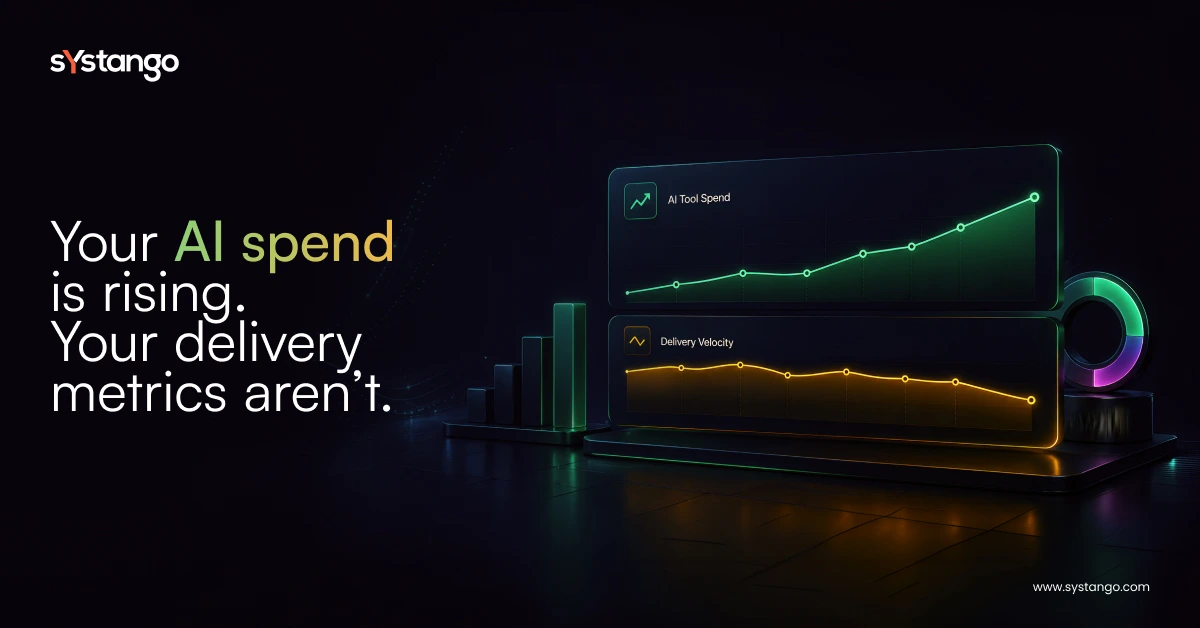
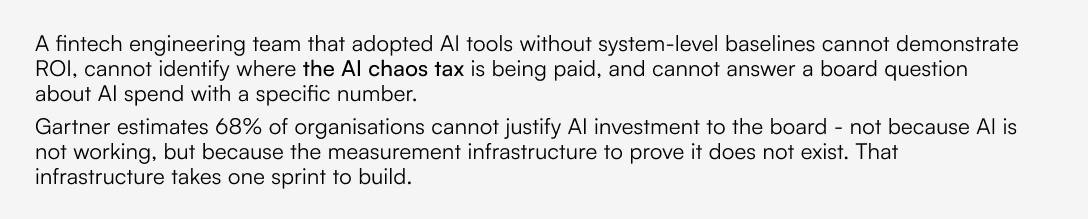
Stack Overflow’s 2024 Developer Survey found that 68% of CTOs cannot quantify the ROI of their team’s AI tool spend. Not because AI is not creating value. Because the metrics being tracked do not translate to board language, and the system was not designed to capture the gains before they are reabsorbed.
1. Why task-level gains disappear before they reach your board

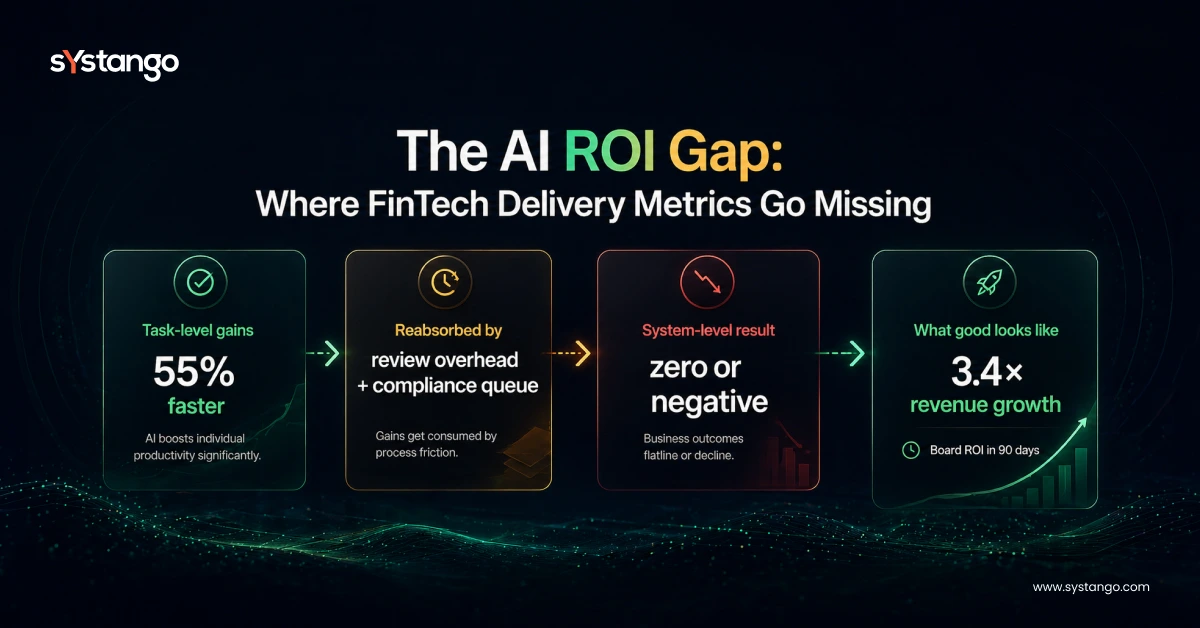
The mechanism behind missing AI ROI fintech delivery metrics is the gap between task-level AI and system-level AI. At the task level, AI tools demonstrably improve individual developer efficiency - GitHub’s research shows developers complete individual tasks 55% faster. Those gains are real.
At the system level - sprint throughput, time-to-market, defect escape rate, engineering throughput KPIs the gains frequently disappear. Forrester Research found that in 40% of organisations, developer velocity declining at the system level despite task-level gains. Task-level time savings are reabsorbed by three system-level costs: reviewing and correcting AI output, managing tool inconsistency, and processing compliance overhead on AI-assisted code.
In fintech, a fourth absorption mechanism amplifies this: every improvement in development speed that creates a corresponding increase in compliance review queue time produces net zero velocity improvement. KPMG’s FinTech AI Governance Report found 74% of fintech firms adopting AI tools without governance reported no measurable time-to-market improvement in the first year.
2. The measurement gap that makes AI ROI invisible
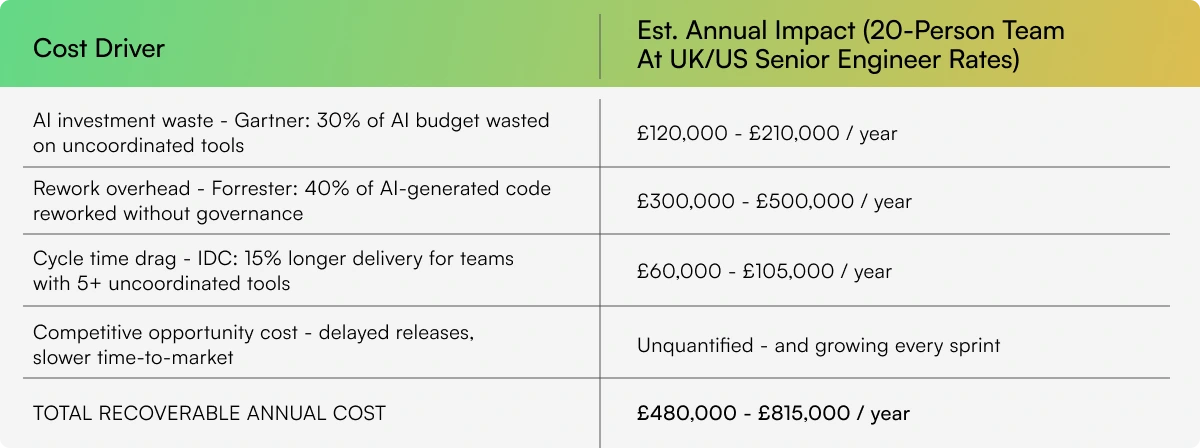
Most FinTech leaders underestimate the cost of missing AI ROI because the costs are distributed, invisible in sprint retrospectives, and never appear as a single line item.
1. 68% of CTOs are presenting the wrong numbers: task speed is not a board metric
Developer task completion speed is not a board number. The metrics that land in a board context are: time-to-market on new product features, compliance review cycle time, defect escape rate, and cost per feature delivered. Stack Overflow’s 2024 survey found 68% of CTOs cannot quantify AI ROI - and Forrester Research explains why: most organisations measure at the task level and manage at the task level, creating the AI chaos tax in aggregate while reporting green at the individual level.

2. 74% of AI-adopted fintechs have no denominator: ROI without a baseline is invisible
You cannot demonstrate AI coding assistant ROI without a documented baseline of what delivery looked like before AI adoption. KPMG’s report found 74% of fintech firms adopting AI tools without governance reported no measurable time-to-market improvement. The most common reason: no one recorded what the baseline looked like before the value started being delivered.
3. 3.4× revenue growth requires a system, not just tools: governance captures the gains
The organisations achieving 3.4 times the revenue growth of non-AI peers are not using more capable AI tools. They are operating with a governance-first AI layer in the SDLC that captures task-level gains at the system level. McKinsey’s research is consistent: AI value accrues to organisations that redesign their delivery processes around AI, not to organisations that add tools to unchanged processes.
3. What fintech teams with board-ready AI ROI do differently
The fintech engineering teams that can walk into a board meeting and show specific, attributable AI ROI share three structural characteristics. None is about which AI tools they use.
1. System-level baselines established before any new AI tool is deployed
Before adopting a new AI tool, high-performing fintech engineering teams establish four baseline metrics: sprint throughput, defect escape rate, compliance review cycle time, and cost per feature delivered. These are the engineering team velocity metrics that translate into board language.
2. ROI attribution built into the governance framework from sprint zero
The teams achieving measurable AI ROI fintech delivery outcomes treat ROI attribution as an engineering deliverable. Every AI governance layer they build includes a measurement component: which AI interactions were used, which produced output that shipped unchanged, and what the sprint-level efficiency delta was versus baseline. Stanford HAI’s research found firms tracking this gap are 2.8× more likely to achieve system-level ROI within 12 months.
3. Two stories presented to the board - and the gap between them explained
The most effective CTO guide to AI tools engineering for board reporting separates two stories explicitly: what individual developers are doing faster (task level), and what the team is delivering differently (system level). When task-level gains are not appearing in system-level outcomes, the divergence is the most important number.
4. Where AI Workbench delivers inside fintech
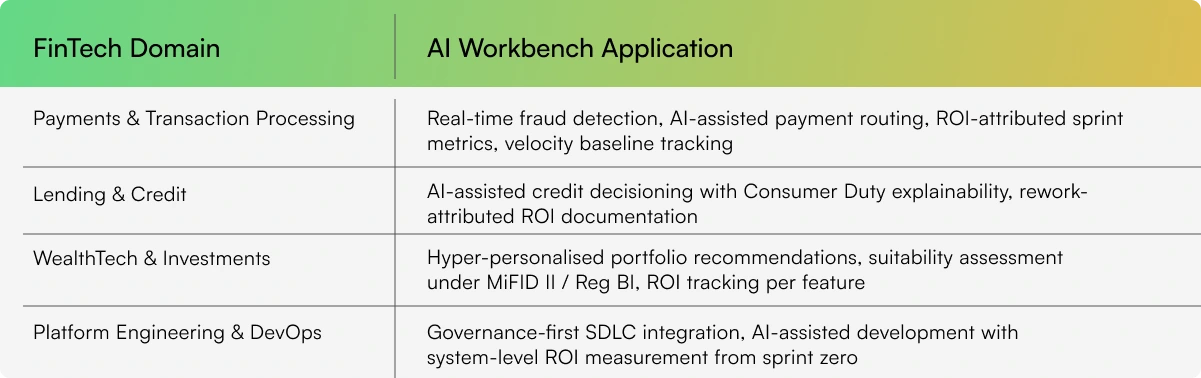
Expected business outcomes the numbers your board needs
Every Systango AI Workbench engagement is tracked against committed baseline metrics from day one. These are documented delivery results - not projections.

Beyond engineering: AI-governed fintech teams ship new product features 30–50% faster than ungoverned counterparts, as McKinsey’s research indicates. Built-in audit trails reduce FCA / OCC review cycle time by up to 40%. Systango clients demonstrate board-level AI ROI within 90 days of AI Workbench deployment - a committed baseline metric agreed before the first sprint begins.
5. Why the board conversation on AI ROI cannot wait until 2027
Every sprint a governed team runs produces measurable, attributable ROI data. Every sprint an ungoverned team runs produces the same measurement void. McKinsey’s analysis indicates firms falling 18+ months behind the AI governance curve face a structural competitive disadvantage that takes 3–5 years to close.
Two forces making 2026 the board-level inflexion point
1. FCA’s AI guidance (2025) - Supervisory expectations are now explicit. Regulated firms without documented AI governance face increasing scrutiny. The grace period has closed.
2. LLM commoditisation cliff (2026) - By late 2026, competitive differentiation will come from how well your engineering system measures, governs, and attributes AI output to board-level outcomes - not which AI tools your developers use.
6. Three calculations to run before your next board meeting
1. Establish your pre-AI baseline for four metrics: sprint throughput, defect escape rate, compliance review cycle time, and cost per feature. If you do not have these numbers, you cannot demonstrate AI ROI fintech delivery to the board. The ROI Calculator shows you exactly which baseline numbers to capture and where to find them in your existing tooling.
2. Audit your current AI tool attribution: for each AI tool in use, can you identify which PRs used it, which shipped unchanged, and what the review outcome was? Tag AI tool usage in your next sprint’s ticket metadata. Two sprints of that data produce a before-and-after ROI statement your board can act on.
3. Calculate your current software delivery velocity fintech gap: take your average PR merge time, code review rounds, and compliance sign-off time, and compare to the governed AI benchmarks in the ROI Calculator. The gap is your board number - the recoverable AI chaos tax your team is paying every sprint, calculable in five minutes against your actual cost base.
About Systango
Systango is a publicly listed AI-native digital engineering company. We build governance-first AI systems for regulated FinTech, WealthTech, and InsurTech organisations in the UK and the US. From funded startups to enterprises including Google and Cisco, we are our customers’ technology partner - AI-native by design, governance-first by principle, outcome-accountable by default.