

Generative AI Strategy 2026: Transforming Enterprise Workflows & Growth
Last Updated on: March 10, 2026
Boards aren’t asking “Should we adopt AI?” anymore—they’re asking, “How do we deploy it safely and at scale?”
In 2026, generative AI is becoming the core operating layer for enterprises, driving faster decisions, smarter workflows, and measurable ROI.
From AI agents to domain-specific LLMs, this blog guides leaders on turning experimentation into competitive advantage.
What’s Inside
I. Generative AI Is Now an Operating Layer
II. What Are Generative AI & AI Agents?
III. Structural Forces Driving Generative AI Adoption
IV. Where Generative AI Applications Are Creating Enterprise Value
VI. Key Generative AI Trends 2026 to Watch
VII. Building a Generative AI Strategy for Enterprises 2026
IX. Future Outlook: 2027 and Beyond
Key Takeaways
Generative AI applications in 2026 have evolved from experimental tools into enterprise infrastructure. Powered by large language models, multimodal systems, and AI agents, these technologies generate content, automate workflows, analyse complex datasets, and execute decisions across business systems. Unlike traditional automation, generative AI systems operate contextually — integrating across platforms, learning from feedback, and triggering actions autonomously. Enterprises are embedding AI agents into customer service, logistics, finance, healthcare, and manufacturing to improve operational efficiency, reduce costs, and accelerate decision-making. With regulatory frameworks tightening and responsible AI becoming mandatory, successful deployments now require strong governance, measurable ROI, and scalable architecture. In 2026, generative AI is not just about productivity gains; it is about building adaptive, intelligent enterprise systems that continuously optimise performance and competitive advantage.
I. Generative AI Is Now an Operating Layer
In 2026, generative AI applications are no longer experimental tools inside innovation labs. They are becoming core operating layers inside enterprises.
Boards are no longer asking “Should we try AI?”
They are asking “How do we deploy AI agents safely, measurably, and at scale?”
PwC estimates AI’s broader impact could reach up to $15.7 trillion by 2030. Meanwhile, Gartner predicts that by 2026, over 80 % of enterprises will have deployed generative AI‑enabled applications in production environments.
The shift is clear:
AI is moving from assistance to autonomous execution.
II. What Are Generative AI & AI Agents?
Generative AI refers to models capable of creating new content — text, code, images, audio, or synthetic data — based on learned patterns.
AI agents extend this capability. They:
- Interpret input
- Make decisions
- Trigger system actions
- Operate across multiple tools autonomously
In 2026, enterprise generative AI solutions increasingly revolve around agentic workflows, not standalone chat interfaces.
III. Structural Forces Driving Generative AI Adoption
1. Operational Pressure
Enterprises must increase output without proportionally increasing headcount.
2. Cost Compression
AI-driven automation reduces repetitive manual intervention.
3. Governance Mandates
Generative AI regulatory concerns 2026 include privacy, bias, hallucinations, and auditability — forcing structured deployment.
IV. Where Generative AI Applications Are Creating Enterprise Value
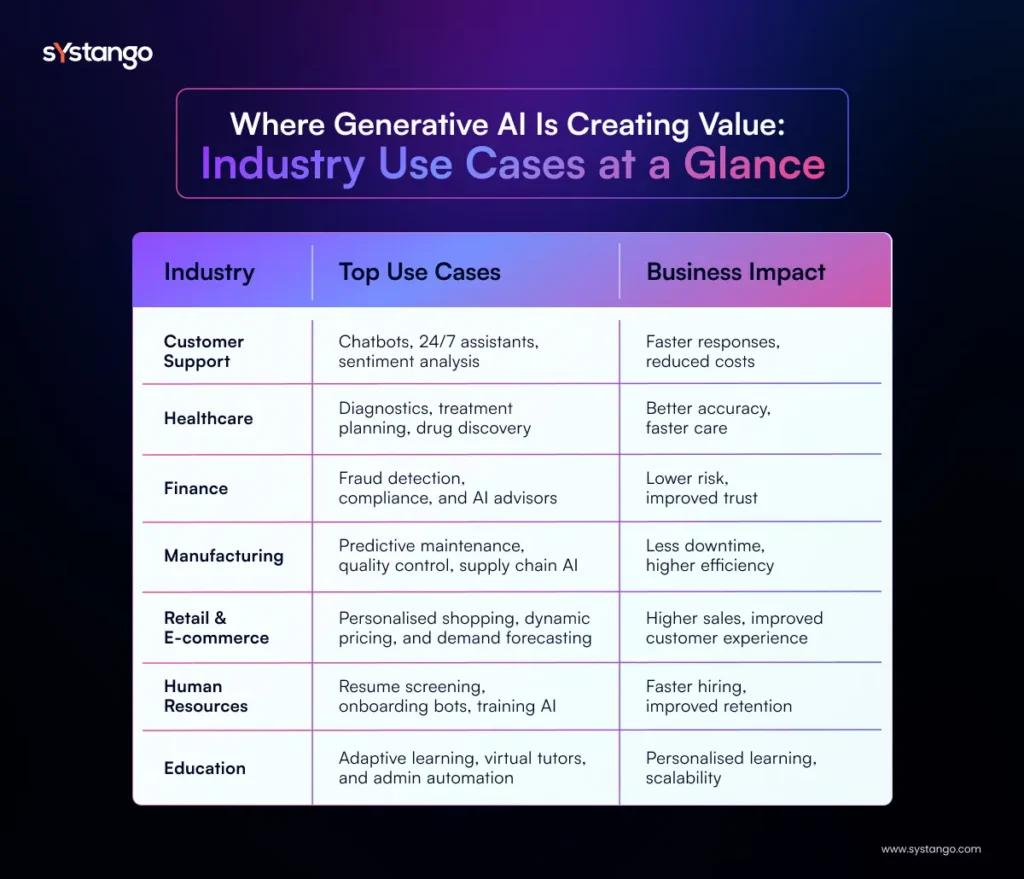
1. Customer Support
AI agents provide 24/7 assistance, sentiment analysis, and automated ticket resolution — reducing response times and support costs.
2. Healthcare
LLM-powered summarisation, diagnostics assistance, and research acceleration.
3. Finance
Fraud detection, compliance automation, and AI-driven advisory systems.
4. Manufacturing
Predictive maintenance, anomaly detection, and quality control.
5. Retail & E-commerce
Dynamic pricing, demand forecasting, personalised recommendations.
6. HR & Education
Resume screening, adaptive learning, onboarding automation.
These real-world use cases of generative AI demonstrate measurable enterprise ROI rather than experimentation.
V. Real Enterprise Impact
1. AI-Driven Logistics Optimisation
A leading logistics platform partnered with Systango to deploy AI agents and intelligent automation. Outcomes:
- 25% faster delivery completion times
- 40% improvement in operational efficiency
- 2.5× scalability in order volume handling
- 20% reduction in operational costs
2. AI + Blockchain Platform Intelligence
A blockchain-enabled platform integrated AI-enhanced analytics and automation for user engagement and operational growth. Results:
- 35% increase in user confidence and trading activity
- 50% faster onboarding and strategy adoption
- 2.5× improvement in platform scalability
- 30% boost in user retention
These outcomes illustrate how generative AI applications extend beyond efficiency gains to drive scalable growth, improved engagement, and measurable ROI.
VI. Key Generative AI Trends 2026 to Watch
- Agentic Workflows – Autonomous execution chains
- Fine-Tuned Domain LLMs – Smaller, cost-efficient specialised models
- Multimodal Systems – Text + image + video + voice integration
- Synthetic Data – Training models when real data is scarce
- Responsible AI Frameworks – Bias reduction, explainability, governance
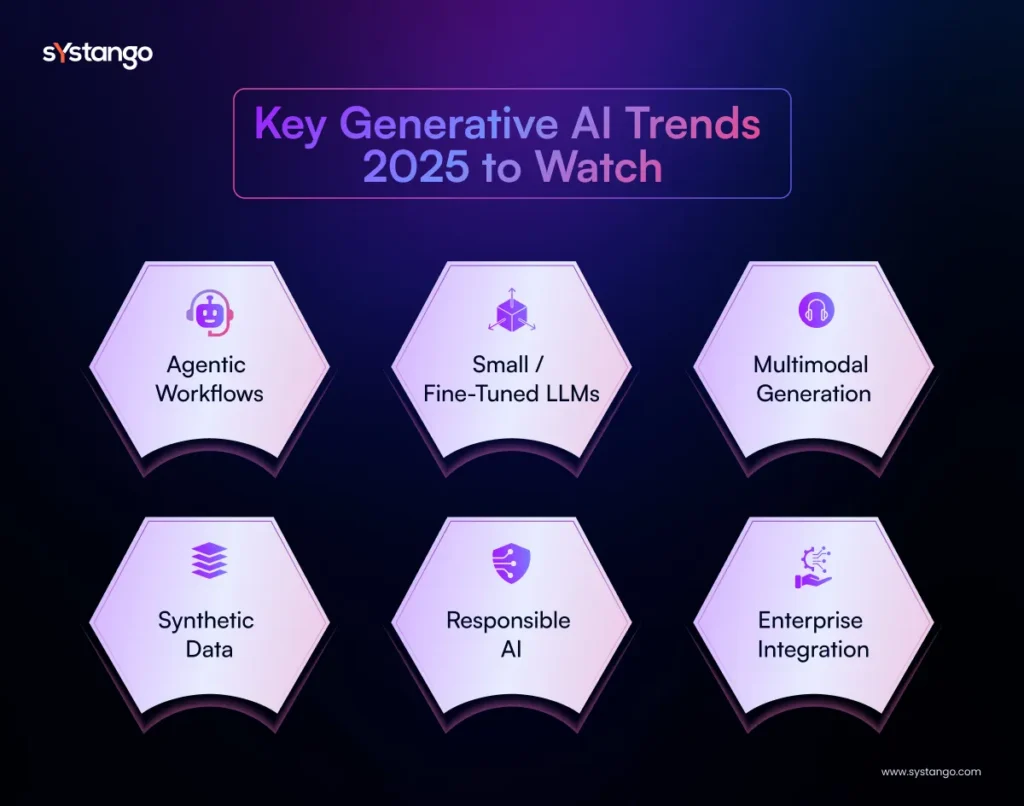
The future of generative AI in 2026 is architecture-driven, not tool-driven.
VII. Building a Generative AI Strategy for Enterprises 2026
To move from experimentation to scale:
Step 1: Start With ROI-Measurable Pilots
Customer support bots, fraud detection, operational optimisation.
Step 2: Ensure Data Governance
Clean datasets, role-based access, audit trails.
Step 3: Choose the Right Model Architecture
Small fine-tuned LLMs when precision is required.
Step 4: Embed Human Oversight
Reduce hallucination risk through feedback loops.
Step 5: Define KPI Measurement
Measure:
- Time saved
- Cost reduction
- Error rate
- Revenue uplift
- Customer satisfaction
Generative AI strategy for enterprises 2026 must be performance-tracked, not hype-driven.
VIII. Risk of Inaction
Enterprises delaying AI integration risk:
- Operational inefficiency versus competitors
- Talent migration to AI-enabled organisations
- Higher long-term automation costs
- Reduced innovation velocity
In 2026, generative AI applications are no longer optional competitive tools — they are structural differentiators.
IX. Future Outlook: 2027 and Beyond
- AI agents orchestrating full business workflows
- Domain-specific LLM ecosystems
- Regulatory AI audit frameworks
- Sustainable AI systems & carbon-efficient models
- Cross-platform enterprise AI integration
Generative AI trends 2026 indicate acceleration, not plateau.
X. Strategic Takeaways
- Generative AI applications are becoming enterprise infrastructure
- AI agents outperform standalone tools
- Governance and architecture define long-term success
- ROI measurement is mandatory
- Early adopters compound competitive advantage
Strategic Summary
Generative AI applications in 2026 are transforming enterprises from tool-driven automation to agent-driven execution. Organisations are embedding AI agents across customer support, finance, logistics, and analytics to drive measurable ROI in cost reduction, scalability, and operational efficiency. With trends such as multimodal AI, domain-specific LLMs, synthetic data, and responsible governance frameworks shaping adoption, success now depends on architecture, compliance, and performance tracking. Enterprises that implement a structured generative AI strategy for 2026 — grounded in measurable pilots and governance with the help of a reliable AI development partner such as Systango — gain sustained competitive advantage, while late adopters risk falling behind in speed, cost optimisation, and innovation velocity.
Conclusion
In 2026, generative AI applications are redefining how enterprises operate, compete, and innovate. From AI agents for industry 2026 to enterprise generative AI solutions embedded across workflows, organisations that adopt strategically — with governance and ROI clarity — will lead their sectors.
The question is no longer whether generative AI will reshape your industry.
The question is whether you will architect it correctly.
With Systango’s expertise in AI software development and enterprise integration, businesses can deploy scalable, compliant, and ROI-driven generative AI solutions, transforming operational workflows into competitive advantage.
Early adopters accelerate decision-making, optimise costs, and drive innovation, while laggards risk inefficiency and lost market share.
Executive Summary
In 2026, generative AI applications are redefining enterprise competitiveness. Organisations deploying AI agents across operations, customer engagement, and analytics are realising measurable gains in efficiency, scalability, and revenue performance. Real-world implementations demonstrate up to 40% operational improvements, 2.5× scalability gains, and significant cost reductions through workflow automation and intelligent decision systems.
However, sustainable value requires more than tool adoption. Enterprises must architect AI-native workflows, embed governance frameworks, and measure ROI through structured KPIs. Trends such as multimodal AI, domain-specific LLMs, and agentic orchestration are accelerating adoption, while regulatory scrutiny demands explainability and compliance by design.
The competitive divide is widening. Enterprises that operationalize generative AI strategically in 2026 will compound advantages in speed, cost structure, and innovation velocity. Those that delay risk structural inefficiency in increasingly AI-augmented markets.