


Generative AI in Legal Database Management: From Information Retrieval to Decision Intelligence
Last Updated on: March 10, 2026

Legal organisations are under pressure to deliver faster advice, manage growing regulatory complexity, and control operating costs — all while sitting on vast volumes of under-utilised knowledge.
Generative AI is turning that dormant data into a real-time decision system.
This is not a tooling upgrade — it is a structural shift in how legal services are produced and priced.
What’s Inside
I. The Knowledge Bottleneck in Modern Law Firms
II. How Generative AI Works in Legal Database Management
III. Proof in Practice: Enterprise Implementation
IV. Security & Compliance: The Non-Negotiable Layer
VI. Implementation Strategy for Law Firms
VII. Future of Legal AI (2026 and Beyond)
VIII. Strategic Takeaways for Legal Leaders
Key Takeaways
- Legal databases are moving from search tools to AI decision systems
- RAG + vector databases enable context-aware legal retrieval
- Secure private LLM deployment is critical for compliance
- ROI comes from faster matter turnaround and lower operational cost
- Early adopters are redesigning legal operating models, not just automating tasks
I. The Knowledge Bottleneck in Modern Law Firms
Legal organisations are sitting on decades of contracts, case law, compliance records, and advisory documents — but most of that knowledge is not operationally usable.
Traditional systems:
- store documents
- index metadata
- return keyword matches
They do not deliver answers.
This is why AI-powered legal document management and legal knowledge management AI have become board-level priorities.
According to McKinsey’s generative AI research, legal workflows are among the highest-impact areas for AI-driven productivity gains, with knowledge-intensive tasks seeing 20–60% efficiency improvement potential. Mckinsey
The shift is not about faster search.
It is about decision velocity.
II. How Generative AI Works in Legal Database Management
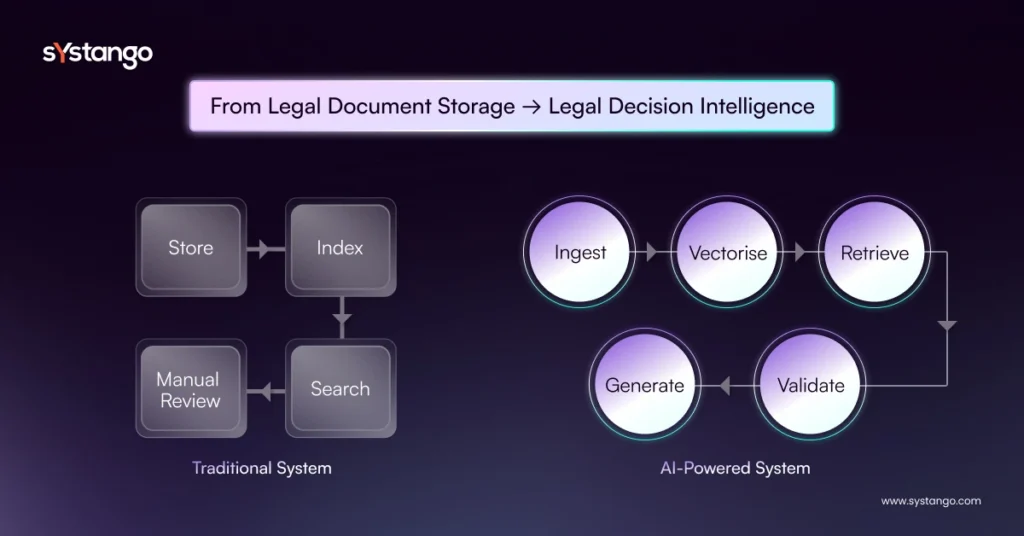
Modern AI legal data extraction services use a layered architecture:
1. Ingestion & Structuring
NLP in legal document processing extracts:
- clauses
- entities
- obligations’
- risk signals
2. Vectorisation
Documents are stored in vector databases for legal AI, enabling semantic retrieval instead of keyword search.
3. Retrieval-Augmented Generation (RAG)
The LLM:
- retrieves only relevant legal context
- generates grounded, auditable responses
This is how AI hallucination prevention in legal workflows is achieved.
4. Human-in-the-loop validation
Ensures regulatory and ethical control.
Gartner identifies this RAG-based enterprise AI pattern as the dominant architecture for domain-critical deployments. Gartner
III. Proof in Practice: Enterprise Implementation
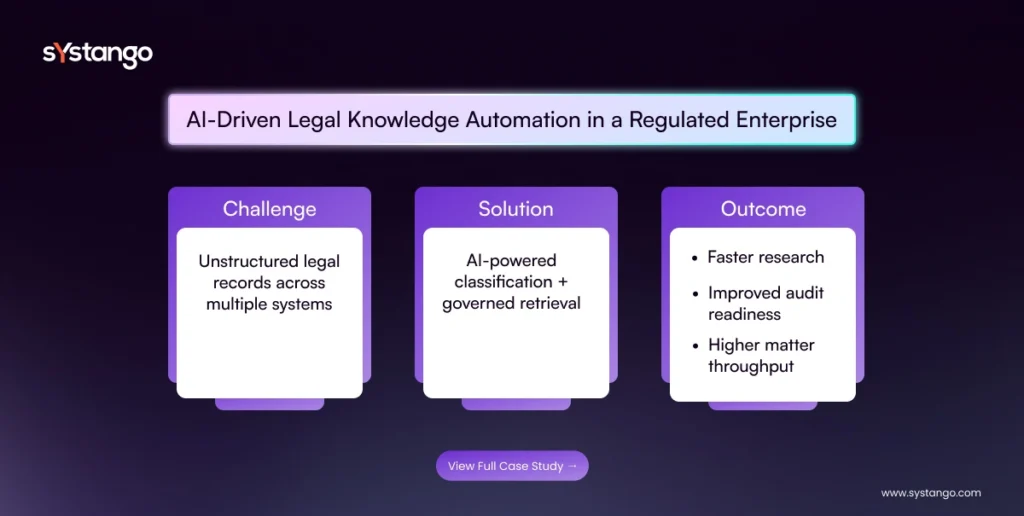
A global professional services organisation implemented a governed AI knowledge system to automate document discovery and classification across millions of records — reducing manual research time and improving response accuracy for client queries.
A regulated financial platform deployed a secure AI data extraction workflow to structure large volumes of unorganised documents for faster compliance and audit readiness.
Both cases demonstrate that enterprise AI implementation for law firms is primarily a data engineering + governance challenge, not a model selection problem.
IV. Security & Compliance: The Non-Negotiable Layer
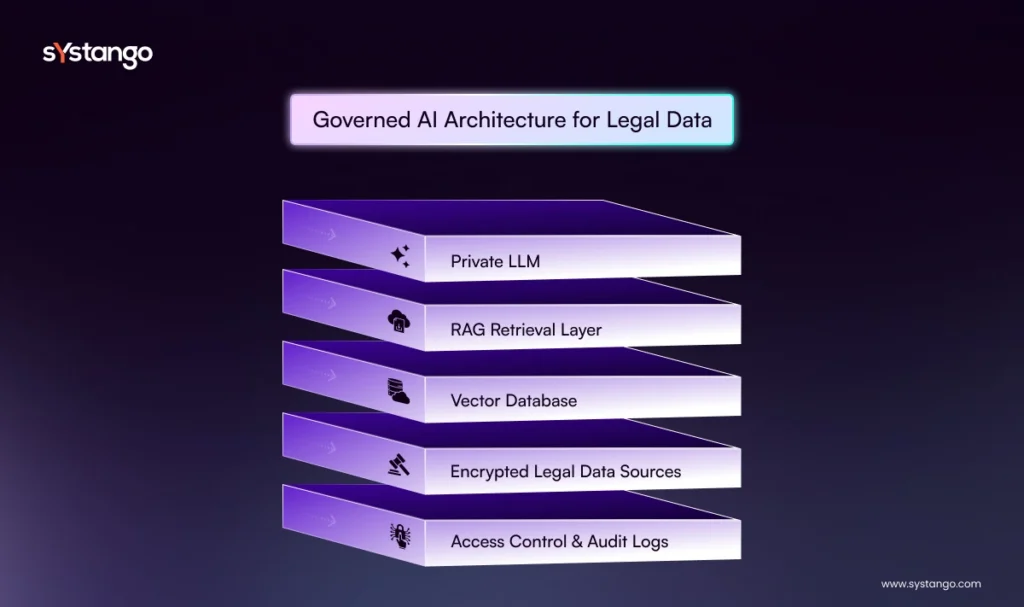
For legal teams, AI compliance automation tools must operate within:
- private deployments
- encrypted pipelines
- audit logs
- access controls
Deloitte’s AI governance research shows that trust architecture is now the primary blocker to enterprise AI adoption, not technology maturity.
This is why secure AI infrastructure for legal enterprises determines whether AI remains a pilot — or becomes production.
V. ROI & Business Impact
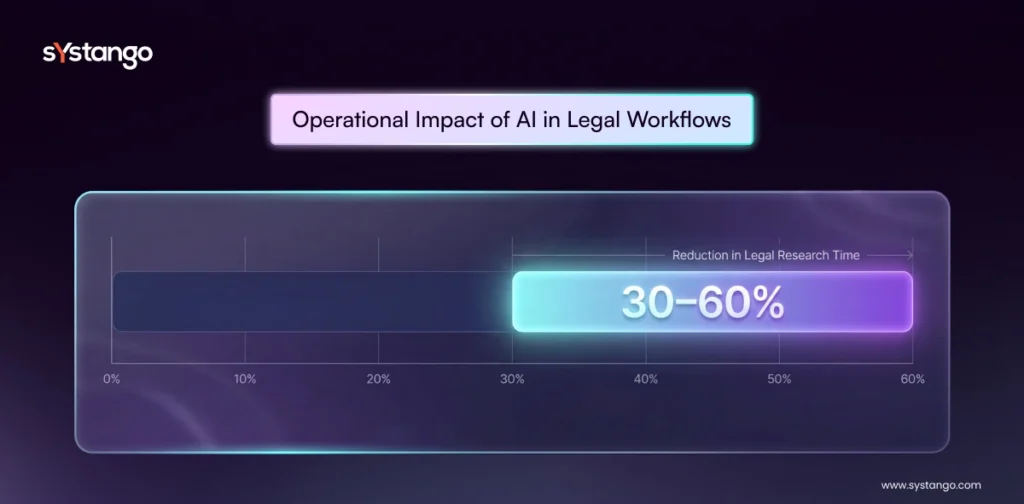
The measurable value of generative AI in legal industry deployments:
- 30–60% reduction in research time
- Faster contract lifecycle turnaround
- Higher matter throughput without increasing headcount
- Lower compliance risk exposure
This directly improves:
- pricing models
- client response time
- operating margins
ROI is not just cost reduction.
It is revenue capacity expansion.
VI. Implementation Strategy for Law Firms
1. Identify high-volume knowledge workflows
2. Structure legal data pipelines
3. Deploy RAG with private LLMs
4. Implement governance framework
5. Redesign legal operating model around AI outputs
This is where custom AI solutions for legal firms move from experimentation to transformation.
VII. Future of Legal AI (2026 and Beyond)
AI-Native Legal Knowledge Systems
Legal databases will evolve into conversational decision platforms where lawyers interact with institutional knowledge in real time — compressing research cycles and fundamentally changing how legal services are priced and delivered.
Regulatory-Embedded AI
Governance will be built into system architecture, turning compliance from a manual checkpoint into an automated, continuous control layer — a critical shift as AI regulation tightens globally.
Unified Matter Intelligence
Integration between AI for contract lifecycle management, legal CRMs, and knowledge systems will create a single operational view of risk, obligations, and precedent.
GitHub’s Octoverse shows rapid enterprise growth in AI-native system development, signalling that domain-trained architectures — not generic copilots — will define long-term advantage.
VIII. Strategic Takeaways for Legal Leaders
- AI in legal is an operating model shift, not a tooling upgrade
- The competitive gap will be created by governed data, not better prompts
- Firms that delay will face structural cost disadvantage
- Knowledge speed will become a pricing differentiator
Strategic Summary
Generative AI in the legal industry is transforming how firms manage, retrieve, and activate institutional knowledge. By combining AI for legal database management, retrieval-augmented generation (RAG), and secure enterprise AI infrastructure, legal teams are reducing research time by up to 60%, improving compliance accuracy, and turning static repositories into decision-intelligence systems. For firms under cost and regulatory pressure, the shift is no longer experimental — it is architectural. Systango enables this transition through governed, domain-trained AI deployments tailored for legal workflows.
Conclusion
The real question is no longer “How can generative AI improve legal database management?”
It is:
Who will own the fastest, most reliable legal knowledge system in their market?
Legal organisations that invest in secure, domain-trained AI architectures today will:
- deliver advice at unprecedented speed
- scale without linear hiring
- reduce regulatory exposure
- increase matter profitability
This transformation is not about adopting a new tool — it is about redesigning how legal value is created and delivered.
This is where enterprise AI solutions for law firms move from pilots to production systems — turning static repositories into governed, revenue-enabling decision intelligence.
Systango partners with legal enterprises to architect and deploy compliant, production-ready AI environments that convert complex legal data into scalable, trusted, and commercially impactful knowledge systems.
Executive Summary
Generative AI is redefining legal database management by transforming static repositories into intelligent, searchable, and reusable knowledge systems. By combining LLMs, vector databases, and retrieval-augmented generation, legal enterprises can automate document classification, accelerate research cycles, improve compliance traceability, and significantly reduce operational cost. This shift moves legal teams from manual, effort-driven workflows to scalable, insight-led operations.
The business impact is measurable. Automation can handle a substantial portion of legal tasks, enabling faster matter turnaround, lower cost per contract, and higher lawyer utilisation. However, successful implementation requires more than model access — it demands secure infrastructure, governance frameworks, and domain-tuned architectures.
Forward-looking firms are adopting AI-native legal knowledge systems that integrate with enterprise platforms and regulatory requirements. Those that delay risk scaling cost instead of capability.
Systango partners with legal organisations to design compliant, production-ready AI environments that convert complex legal data into decision intelligence — enabling scalable delivery without linear headcount growth.