

Beyond Support: AI-Optimised Cloud Managed Services for Multi-Cloud Cost Governance in 2026
Last Updated on: March 3, 2026

In 2026, cloud infrastructure isn’t just a technology platform — it has become a critical financial governance system for enterprises.
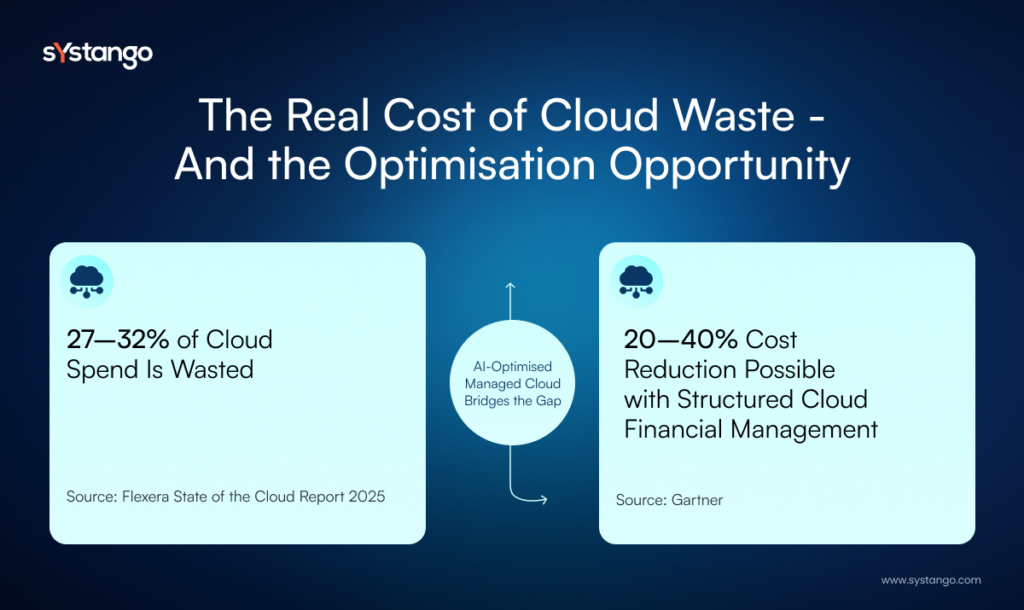
According to Flexera’s 2025 State of the Cloud Report, organisations estimate that around 27% of cloud spend is wasted, down from about 32% in previous years, highlighting the ongoing need for cost governance
Gartner also highlights that AI is becoming embedded across cloud services and IT operations, fundamentally transforming infrastructure management. and FinOps practices.
Cloud adoption accelerated digital transformation, but it also introduced unprecedented complexity — especially for enterprises operating across AWS, Alibaba, and Google Cloud.
Today’s challenge is no longer uptime.
It’s predictable cost, secure governance, and multi-cloud interoperability.
What’s Inside
I. Enterprise Cloud Challenge: Complexity Meets Cost
II. Strategic Insight: Cloud Governance Is the New Enterprise Control Plane
III. What Are Managed Cloud Services in 2026?
IV. Reactive Cloud vs AI-Optimised Managed Cloud
V. Financial Governance in Multi-Cloud Environments
VI. Real Enterprise Proof: Governance in Action
VII. Strategic Implementation Framework
IX. Future Outlook: Cloud Governance in 2026+
Key Takeaways
This executive guide explains how cloud managed services have evolved into:
- AI-powered governance systems
- Multi-cloud cost control layers
- Enterprise risk mitigation frameworks
- Strategic cloud transformation engines
It covers:
- A new definition of cloud managed services (2026)
- Why AI-powered cloud management matters
- Structural multi-cloud governance model
- Managed vs reactive cloud comparison
- Real enterprise proof
- Strategic implementation framework
- Risk of inaction
- Future outlook
Designed for CTOs, CFOs, and enterprise leaders seeking structured cloud control.
I. Enterprise Cloud Challenge: Complexity Meets Cost
Most cloud environments today suffer from:
- Fragmented cost visibility across platforms
- Reactive optimisation cycles
- Siloed security and compliance controls
- Manual incident response
- Unpredictable AI workload costs
This fragmentation results in wasted spend, operational drag, and compliance risk — especially when workloads span multiple clouds.
Unless cloud operations are transformed into governance infrastructure, organisations will continue to lose visibility and financial control.
II. Strategic Insight: Cloud Governance Is the New Enterprise Control Plane
Modern cloud excellence is not defined by uptime or feature count.
It is defined by:
- Margin predictability
- Cross-cloud governance
- Automated compliance
- AI-driven optimisation
- Financial transparency
Through AI-powered cloud management, enterprises can automate monitoring, eliminate idle resources, and enforce policy-driven controls that reduce waste and risk.
The era of manual cloud operations is over.
The era of predictive cloud governance has begun.
III. What Are Managed Cloud Services in 2026?
Cloud managed services in 2026 extend beyond outsourcing tasks.
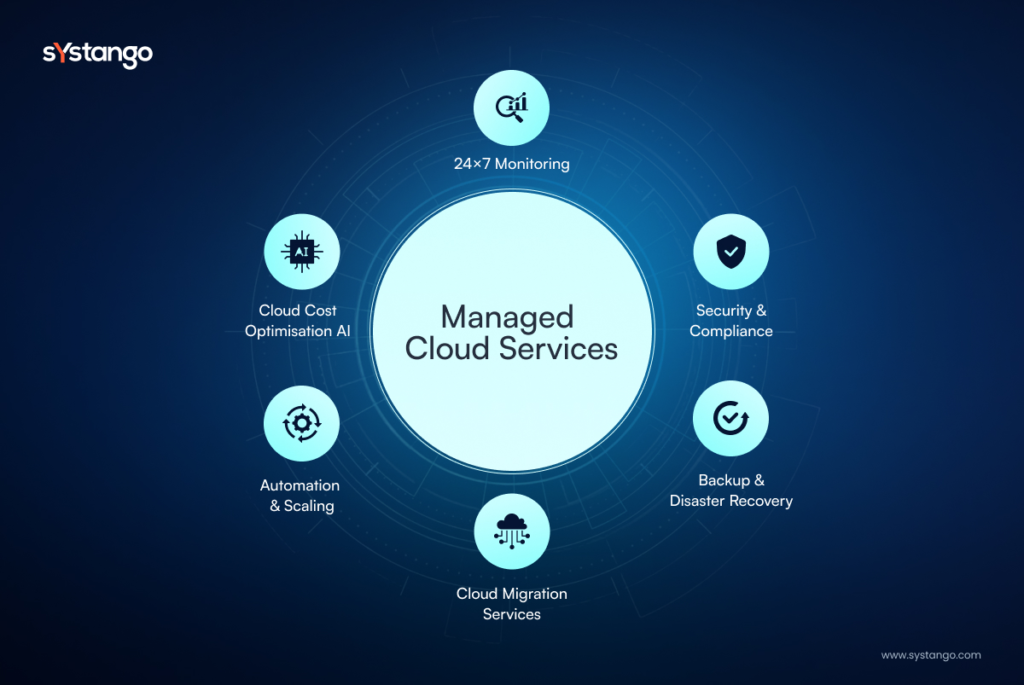
They represent AI-augmented governance infrastructure that:
- Enforces security and compliance
- Automates operations 24×7
- Integrates multi-cloud visibility
- Implements cost governance frameworks
- Delivers predictive scaling and optimisation
- Supports structured cloud migrations
Key capabilities include:
- Continuous automated monitoring
- Predictive anomaly detection
- Policy-based FinOps controls
- Multi-cloud orchestration dashboards
- Cloud cost optimisation AI insights
- AI-assisted incident response
These services are delivered by specialised cloud service providers who act as strategic partners — not just vendors.
IV. Reactive Cloud vs AI-Optimised Managed Cloud
| Reactive Cloud Model | AI-Optimised Managed Cloud |
| Manual monitoring | Automated 24×7 monitoring |
| Periodic cost reviews | Continuous cloud cost optimisation AI |
| Siloed cloud accounts | Unified multi-cloud governance |
| Ad hoc incident response | Predictive anomaly detection |
| Manual migrations | Structured cloud migration services |
| Cloud sprawl | Controlled multi-cloud orchestration |
This clarifies the strategic difference between legacy operations and governance-first cloud practice.
It is worthy noting that 27–32% of cloud spend is wasted due to underutilised resources and poor governance while 20–40% cost savings are achievable through structured cloud financial management (FinOps).
V. Financial Governance in Multi-Cloud Environments
Multi-cloud enhances resilience and flexibility — but spreads cost visibility across silos.
Without unified governance:
- Distributed workloads go unmonitored
- Cross-cloud data transfer costs balloon
- Savings from reserved capacity go unused
- Budget forecasting is inaccurate
- Compliance reporting lags
With structured managed cloud services:
- Real-time cost dashboards unify AWS, Azure, GCP data
- Cloud cost optimisation AI detects idle resources
- Rightsizing policies enforce budget discipline
- Predictive cost modelling forecasts next quarter trends
- Multi-cloud orchestration prevents vendor lock-in
Advanced generative AI cloud services further enhance automation by:
- Auto-generating optimisation recommendations
- Explaining anomalous spend trends
- Simplifying cross-cloud fleet configuration
In the multi-cloud era, financial governance is the core enterprise KPI — not an optional tool.
VI. Real Enterprise Proof: Governance in Action
Compliance-Driven Cloud Modernisation
To modernise its cloud operations and support rapid enterprise growth, a leading business partnered with Systango to adopt a governed, AI-augmented cloud management model.
Measured Outcomes:
- 65% reduction in manual data handling effort
- 90% faster compliance reporting
- 2.5× improvement in scalability
- 50% faster feature deployment cycles
Strategic Impact:
Structured managed cloud services reduced operational friction, improved compliance visibility, and accelerated enterprise feature velocity.
This is cloud governance delivering business outcomes — not just operational support.
VII. Strategic Implementation Framework
Modern cloud excellence is achieved through phased execution:
Phase 1: Discovery & Visibility
Conduct cost, performance, and compliance audit across cloud environments.
Phase 2: AI Governance Layer
Deploy AI-powered cloud management and predictive monitoring.
Phase 3: Cross-Cloud Orchestration
Implement unified dashboards, FinOps controls, and multi-cloud policy enforcement.
Phase 4: Continuous Optimisation
Refine automated scaling, cost forecasting, and compliance automation.
This governance-first, phased approach provides a representative roadmap that moves cloud operations from reactive to governance-ready systems.
VIII. Risk of Inaction
Without AI-augmented managed cloud services:
- Cloud waste remains elevated
- Security gaps widen
- Compliance risk increases
- Vendor siloing intensifies
- Innovation slows
- EBITDA margins erode
In 2026, unmanaged cloud is unmanaged financial risk.
IX. Future Outlook: Cloud Governance in 2026+
Enterprises that adopt AI-driven cloud governance frameworks will outperform peers across total cost of ownership and digital acceleration metrics.
Future cloud success depends on:
- AI native orchestration
- Predictive cost intelligence
- Cross-cloud interoperable governance
- Autonomous policy enforcement
2026 will mark the era where controlled cloud governance becomes a competitive moat.
Strategic Takeaways
- Managed cloud services have evolved into governance infrastructure.
- AI-driven optimisation protects margins.
- Multi-cloud orchestration is essential for enterprise control.
- Structured finance and compliance governance improves resilience.
- An implementation framework reduces risk and accelerates benefits.
Strategic Summary
In 2026, cloud managed services have become AI-augmented governance frameworks for multi-cloud enterprises. Through AI-powered cloud management and cloud cost optimisation AI, organisations automate operations, enforce policy-based controls, and eliminate waste across AWS, Azure, and GCP environments. Modern managed services provide predictive monitoring, unified cost dashboards, and governance automation — transforming cloud infrastructure into financially disciplined, performance-aligned systems. Systango’s AI-native cloud governance approach stabilises multi-cloud complexity while improving cost visibility, compliance resilience, and operational throughput.
Conclusion
The cloud doesn’t support infrastructure anymore.
It’s a financial governance and competitive performance system.
Enterprises that adopt AI-optimised managed cloud services and unified multi-cloud governance reduce waste, improve compliance, and accelerate innovation.
Cloud excellence in 2026 is not uptime.
It is strategic control. Achieve it with Systango.
Executive Summary
Cloud operations in 2026 require far more than uptime or reactive support. AI-enabled cloud managed services function as enterprise governance systems that unify cost visibility, automate policy enforcement, and stabilise distributed environments across AWS, Azure, and GCP.
Organisations that implement structured cloud governance using AI-powered cloud management and cloud cost optimisation AI frameworks achieve measurable outcomes in scalability, financial predictability, and operational resilience. Systango’s approach helps enterprises transition from reactive cloud operations to strategic governance, unlocking margin protection, regulatory compliance, and innovation velocity.