

AI in Project Management 2026: The Enterprise Guide to Predictive Delivery and Workflow Automation
Last Updated on: March 3, 2026
Projects are becoming more complex — multi-vendor ecosystems, distributed teams, real-time dependencies, and dynamic scope changes.
Yet most enterprises still rely on dashboards that report yesterday’s problems.
In 2026, AI in project management shifts the paradigm from reactive tracking to predictive control. Machine learning models anticipate delays. AI-powered PM assistants summarise risk in seconds. LLMs generate executive-ready updates instantly.
The question is no longer “Should we use AI?”
It is “How do we implement project management AI automation strategically?”
What’s Inside
I. Why AI in Project Management Is Accelerating
IV. Strategic Framework: How to Implement AI in Project Management
V. Top AI Project Management Tools & Use Cases
IX. Future Outlook: AI + Project Management Roadmap 2026+
Key Takeaways
AI in project management 2026 integrates machine learning, predictive analytics, and LLM project management tools to automate scheduling, optimise resources, anticipate risks, and generate executive insights in real time. Organisations using AI project management tools improve delivery predictability, cost control, and cross-functional visibility. Proper governance and workflow integration determine enterprise-scale ROI.
I. Why AI in Project Management Is Accelerating
According to McKinsey & Company, AI adoption across enterprise functions continues to expand, with organisations reporting measurable productivity and operational improvements.
Similarly, the Project Management Institute highlights in its Pulse of the Profession research that digitally mature organisations achieve significantly higher project success rates.
The macro trend is clear:
- Data volumes are increasing
- Stakeholder expectations are rising
- Decision velocity must accelerate
Traditional PM frameworks are insufficient without predictive intelligence.
II. The Enterprise Challenge
Without AI integration, enterprises face:
- Manual resource conflicts
- Delayed risk detection
- Budget overruns
- Reporting bottlenecks
- Cross-system visibility gaps
Traditional systems describe what happened.
AI predicts what will happen.
III. Strategic Insight
Winning enterprises in 2026 follow this pattern:
Predict → Automate → Orchestrate → Optimise
Rather than layering AI on top of existing tools, they redesign workflows around predictive triggers and automation rules.
This shift defines modern project management AI automation.
IV. Strategic Framework: How to Implement AI in Project Management
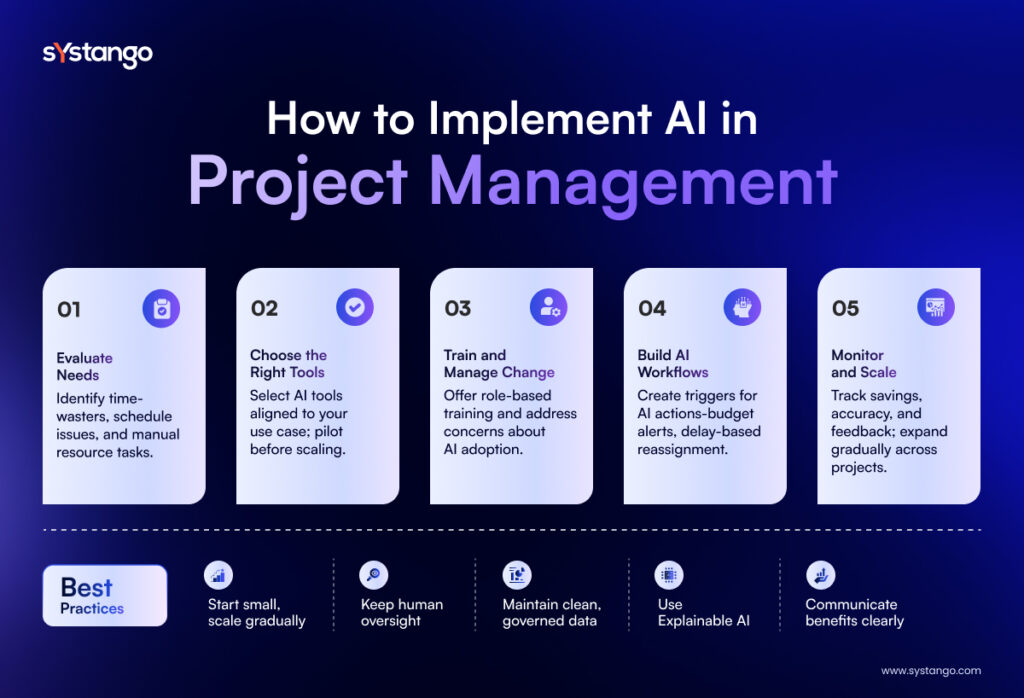
Step 1: Evaluate Needs
Identify schedule slippage, manual reporting load, and resource allocation inefficiencies.
Step 2: Choose the Right AI Project Management Tools
Select tools aligned to use cases like predictive project risk using AI or AI for task scheduling. Pilot before scaling.
Step 3: Train & Manage Change
Address adoption resistance. Emphasise augmentation, not replacement.
Step 4: Build AI Workflows
Trigger AI reviews at budget thresholds or delay indicators. Embed automated project reporting AI into executive dashboards.
Step 5: Monitor & Scale
Track savings, prediction accuracy, and reduction in escalation cycles.
Best Practices:
- Start small, scale gradually
- Maintain human oversight
- Use explainable AI models
- Ensure governed, clean data
V. Top AI Project Management Tools & Use Cases
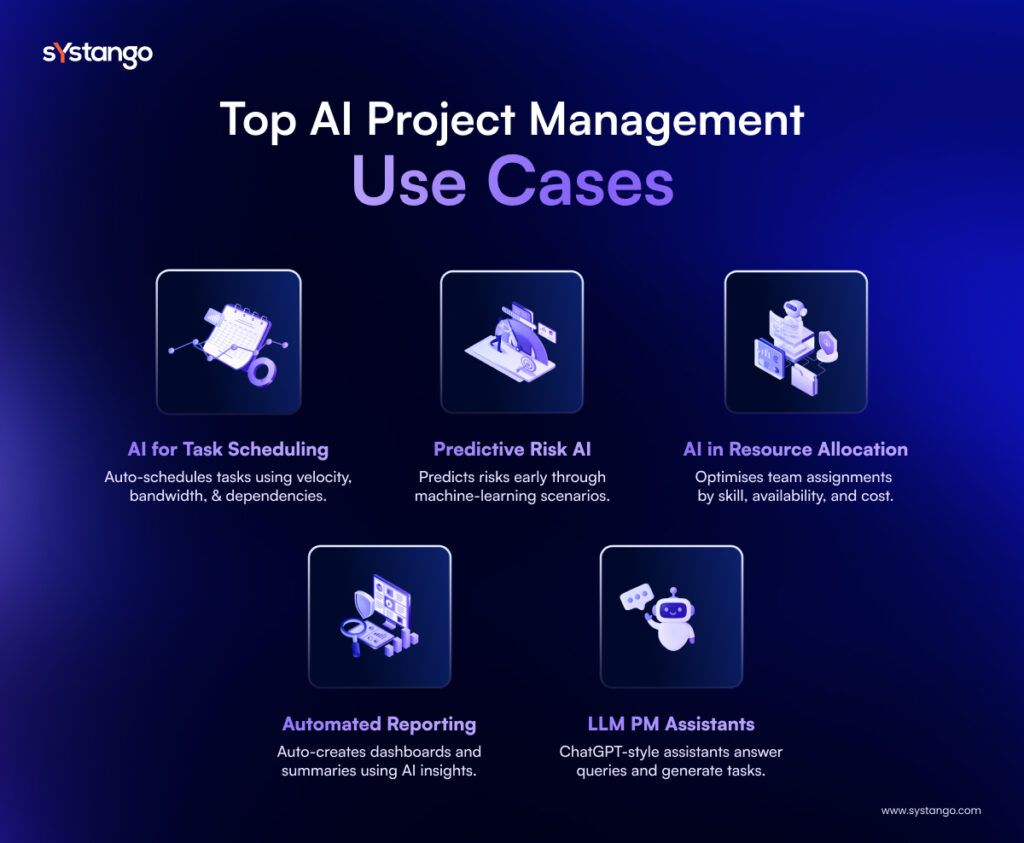
- AI for task scheduling – dynamically adjusts sprint timelines
- Predictive project risk using AI – forecasts overruns early
- AI in resource allocation – optimises skills vs capacity
- Automated project reporting AI – generates executive summaries
- LLM project management tools – ChatGPT for project management queries
These capabilities move PM from documentation to orchestration.
VI. Real World Use Cases
1. AI Legal Operations Transformation
A legal enterprise partnered with Systango to implement AI-powered workflow automation across legal intake, document preparation, and compliance processes.
- 30% increase in workflow efficiency
- 80% faster document turnaround
- 20% reduction in workforce load
- Firm-wide visibility via real-time dashboards
AI-driven automation improved compliance accuracy and delivery speed.
2. AI Carbon Intelligence Platform
A sustainability technology platform collaborated with Systango to build an AI-powered carbon intelligence system that analyses behavioural data and environmental impact at scale.
- 30% reduction in carbon emissions
- 45% increase in sustainable behaviour adoption
- 60% improvement in user engagement
- 50% growth in B2B onboarding efficiency
Structured AI workflows translated analytics into measurable enterprise outcomes.
VII. Business Impact & ROI
Enterprises implementing AI in project management 2026 achieve:
- Reduced schedule variance
- Lower operational waste
- Faster executive decision cycles
- Improved forecasting reliability
- Higher stakeholder transparency
According to research on predictive analytics in enterprise systems, the use of machine learning–driven predictive analytics enables organisations to improve forecasting accuracy and strengthen strategic planning decisions.
AI transforms PM from coordination overhead to strategic intelligence infrastructure.
VIII. Risk of Inaction
Delaying AI adoption leads to:
- Escalating cost of correction
- Slower response to market shifts
- Competitive lag in forecasting capability
- Increasing burnout from manual coordination
Predictive-native organisations will outpace reactive ones.
IX. Future Outlook: AI + Project Management Roadmap 2026+
Expect:
- Autonomous AI-powered PM assistants
- Deeper LLM in project management integration
- Self-adjusting timelines based on live data
- Cross-platform intelligence linking CRM, ERP, DevOps
- Predictive modelling embedded by default
The future of AI in project management is adaptive, conversational, and orchestration-led.
X. Strategic Takeaways
- AI enables predictive, not reactive, execution.
- LLM project management tools improve executive clarity.
- Governance determines scalability.
- Automation reduces risk exposure.
- AI augments leadership, it does not replace it.
Strategic Summary
Enterprises adopting AI in project management 2026 are prioritising:
- Predictive project risk using AI
- AI in resource allocation
- Automated project reporting AI
- LLM in project management for conversational insights
- AI-powered PM assistants for workflow orchestration
However, measurable impact depends on structured implementation and governance-led execution.
Through structured AI consulting services and AI development services, Systango enables enterprises to embed intelligent automation into project workflows — transforming operational control into predictive advantage.
Conclusion
AI in project management 2026 is not a tool upgrade — it is an operating model shift.
Enterprises that integrate predictive intelligence, LLM automation, and structured workflows gain execution resilience, cost efficiency, and competitive agility.
The future of project delivery belongs to organisations that architect AI into their workflow core.
Engineering partners such as Systango help enterprises design and implement AI-driven project workflows, enabling organisations to operationalise intelligent automation and deliver measurable performance outcomes.
Executive Summary
In 2026, AI in project management has evolved into a strategic capability, not just a productivity tool. Organisations are leveraging AI project management tools, predictive analytics, and LLM project management tools to automate scheduling, detect risks early, optimise resource allocation, and generate real-time insights.
Enterprises adopting project management AI automation are achieving:
- Faster, data-driven decision-making
- Reduced budget overruns through predictive project risk using AI
- Improved resource efficiency via intelligent allocation
- Conversational insights through AI-powered PM assistants
Systango case studies show measurable outcomes — including 30% workflow efficiency uplift and 80% faster document turnaround — proving that structured AI adoption delivers real ROI.
The competitive edge in 2026 belongs to organisations that embed AI into workflows, not just tools.