

Why wealthtech platforms are stuck between legacy systems and AI-native delivery and what breaks the deadlock
Last Updated on: May 5, 2026
Key Takeaways
1. The legacy trap: why AI pilots fail at the infrastructure layer
2. Three patterns that keep wealthtech platforms in a deadlock
3. What breaks the deadlock: governance-first platform modernisation
4. Where AI Workbench applies in wealthtech platform modernisation
5. Why the deadlock gets harder to break in 2026
6. Three diagnostics to run on your platform this week
The most dangerous moment in a wealthtech platform AI journey is not when the pilot fails. It is when it succeeds, and the production environment cannot support it.
The Bank of England and FCA’s 2024 survey found 75% of UK financial services firms already using AI – few have infrastructure designed to host it.

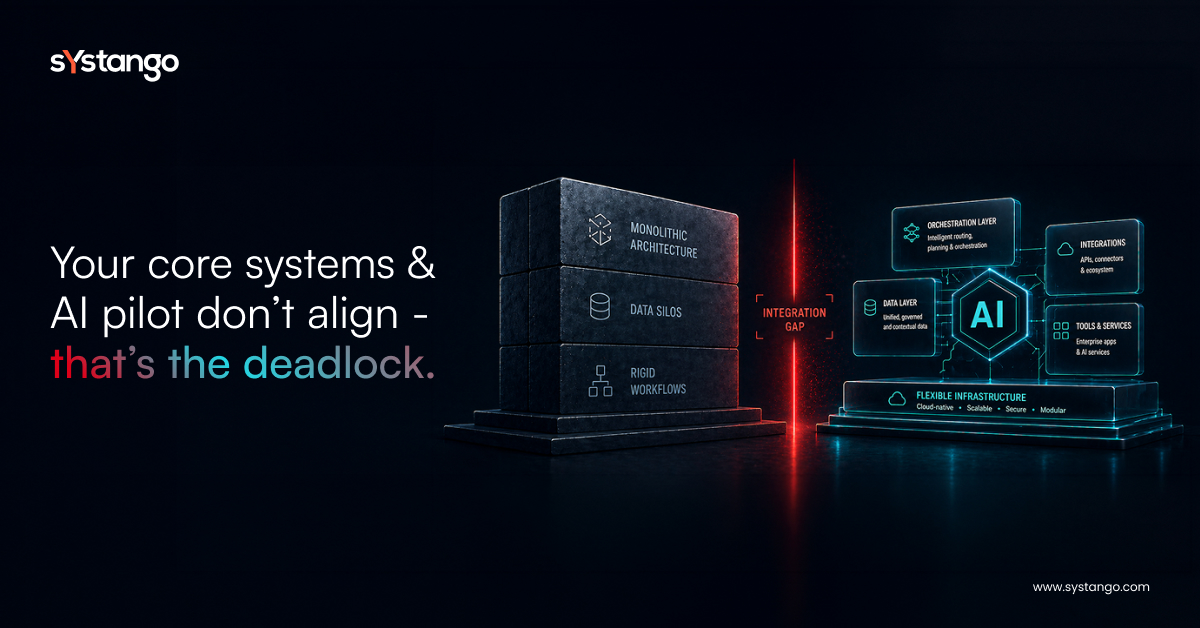
The wealthtech platform challenges that stall AI delivery are infrastructure problems – legacy systems in wealth management that cannot ingest real-time data, support the audit trail MiFID II and Consumer Duty require, or scale to AI inference demands. The deadlock is structural. So is the solution.
1. The legacy trap: why AI pilots fail at the infrastructure layer
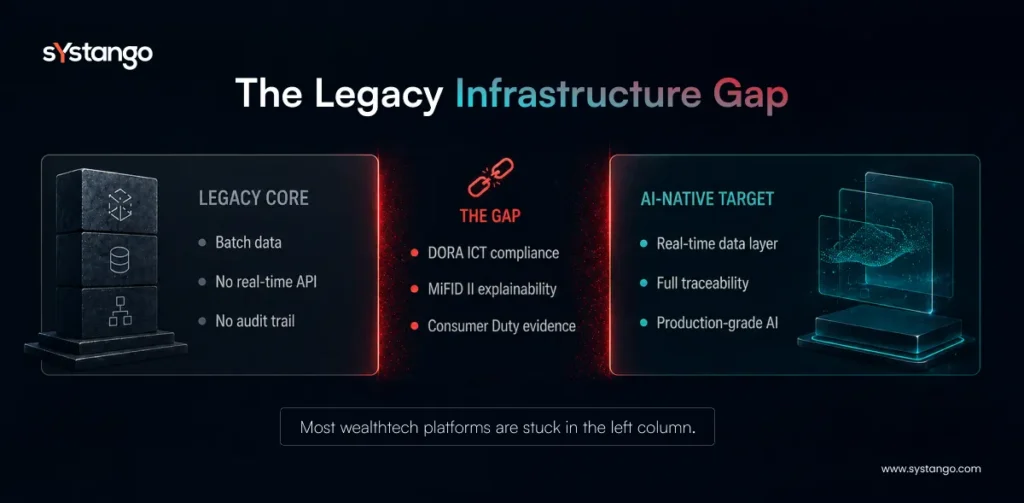
The AI in wealth management platforms problem is an infrastructure gap between where AI pilots run and where they must deploy. DORA (binding January 2025), FCA Consumer Duty, and MiFID II suitability rules each require auditable, explainable AI outputs – and infrastructure built for manual processes cannot carry that governance load.

The AI in wealth management platforms problem is an infrastructure gap between where AI pilots run and where they must deploy. DORA (binding January 2025), FCA Consumer Duty, and MiFID II suitability rules each require auditable, explainable AI outputs – and infrastructure built for manual processes cannot carry that governance load.
2. Three patterns that keep wealthtech platforms in a deadlock
The fintech legacy system modernisation challenge in wealthtech has consistent failure signatures. Recognising them is the first step to escaping them.
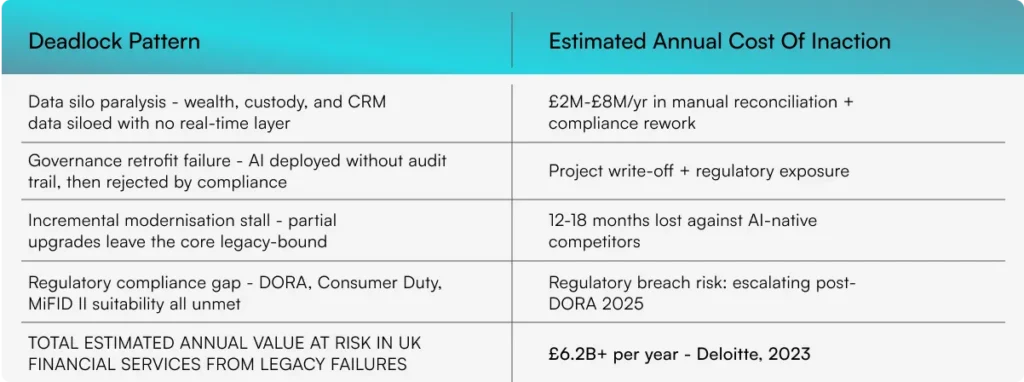
Pattern 1 – The data silo problem: AI models cannot learn from data they cannot reach
Wealthtech platforms hold client data across custody, CRM, portfolio, and compliance systems, never designed to interoperate. Informatica’s CDO Insights survey found 43% of firms identify data quality as their primary AI barrier. The data exists – data silos in financial services keep it inaccessible to production AI systems.
Pattern 2 – The governance retrofit problem: compliance requirements discovered after build are expensive
Platforms that discover Consumer Duty, MiFID II, and DORA requirements after building their AI layer face complete governance retrofits. The governance-first AI layer in the SDLC is not a compliance add-on. It is the architecture decision that makes everything else deliverable.
Pattern 3 – The incremental modernisation trap: partial upgrades preserve the core problem
The most common wealth management platform modernization mistake: upgrading the front end while leaving the legacy core intact. A new advisory UI on a 15-year-old data infrastructure does not produce an AI-native platform. The AI layer inherits every limitation of the infrastructure beneath it.

3. What breaks the deadlock: governance-first platform modernisation
Wealthtech platforms that successfully transition to AI-native delivery share three structural characteristics. None involves rewriting the entire core in one programme.
1. They decouple the data layer first – before the AI model is scoped
A unified, real-time data layer connecting custody, CRM, portfolio, and compliance data is the single architectural prerequisite for production AI in wealth management platform modernisation. Platforms that solve the data silo problem before scoping the AI model avoid the infrastructure blockers that kill most deployments at the production gate.
2. They build the governance layer into the architecture – not the project plan
DORA, MiFID II, and Consumer Duty are architectural constraints, not project deliverables. Platforms that resolve the deadlock build audit trail generation, PII detection, and explainability into the inference layer from sprint one. The governance-first AI layer in the SDLC makes AI output compliance-ready by design.
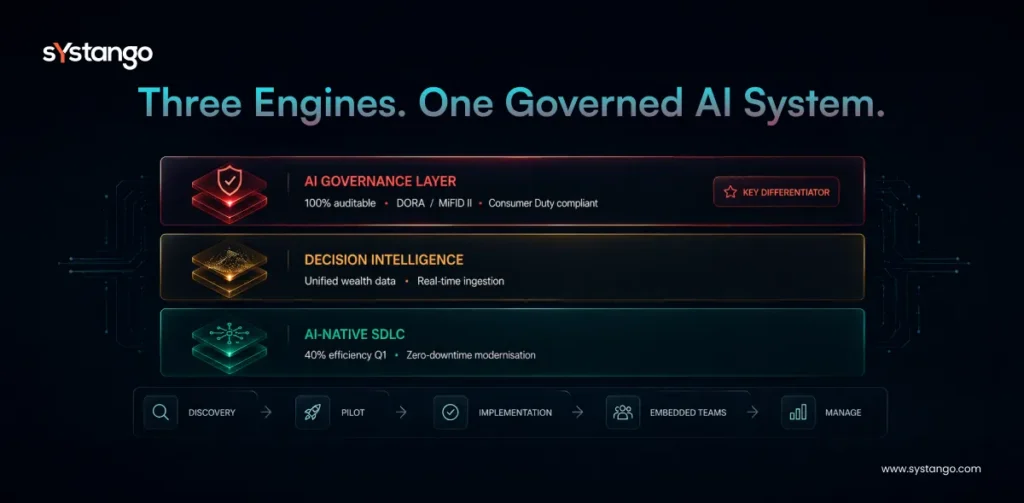
4. Where AI Workbench applies in wealthtech platform modernisation
Expected outcomes – AI-native wealthtech platform delivery
Documented delivery results from live AI Workbench engagements – not projections.

Wealthtech platforms achieve 4× to 36× throughput improvement without proportional cost growth, with DORA, MiFID II, and Consumer Duty documentation generated by the AI system itself. Board-level ROI within 90 days – based on Systango’s delivery data from live AI Workbench engagements.
5. Why the deadlock gets harder to break in 2026
DORA is binding. Consumer Duty is active. ESMA’s MiFID II guidance is the operative standard across the EU and UK. Every quarter of delay accumulates compliance exposure on an architecture never designed to carry it. The robo-advisor market is growing at 30.8% CAGR, according to Mordor Intelligence – AI-native competitors are capturing the addressable market that legacy-bound platforms cannot serve.
6. Three diagnostics to run on your platform this week
1. Map every data source your AI model needs at production scale and document real-time availability. Any batch-only source is your first infrastructure gap.
2. Test your platform against the three DORA ICT resilience requirements: risk management framework, incident response playbook, third-party AI dependency mapping. Each gap grows with every AI capability added before resolving it.
3. Audit your last AI pilot’s governance trail: can it produce MiFID II suitability documentation for a specific client interaction, on demand? If not, it will not pass the FCA or ESMA audit review Consumer Duty enforcement will trigger.
About Systango
Systango is a publicly listed AI-native digital engineering company. We build governance-first AI systems for regulated FinTech, WealthTech, and InsurTech organisations in the UK and US. From funded startups to enterprises including Google and Cisco, we are our customers’ technology partner – AI-native by design, governance-first by principle, outcome-accountable by default.