

DevOps Engineer Hiring Guide (2026): How to Hire the Right DevOps Engineer, Skills, Interviews & Recruitment Strategies
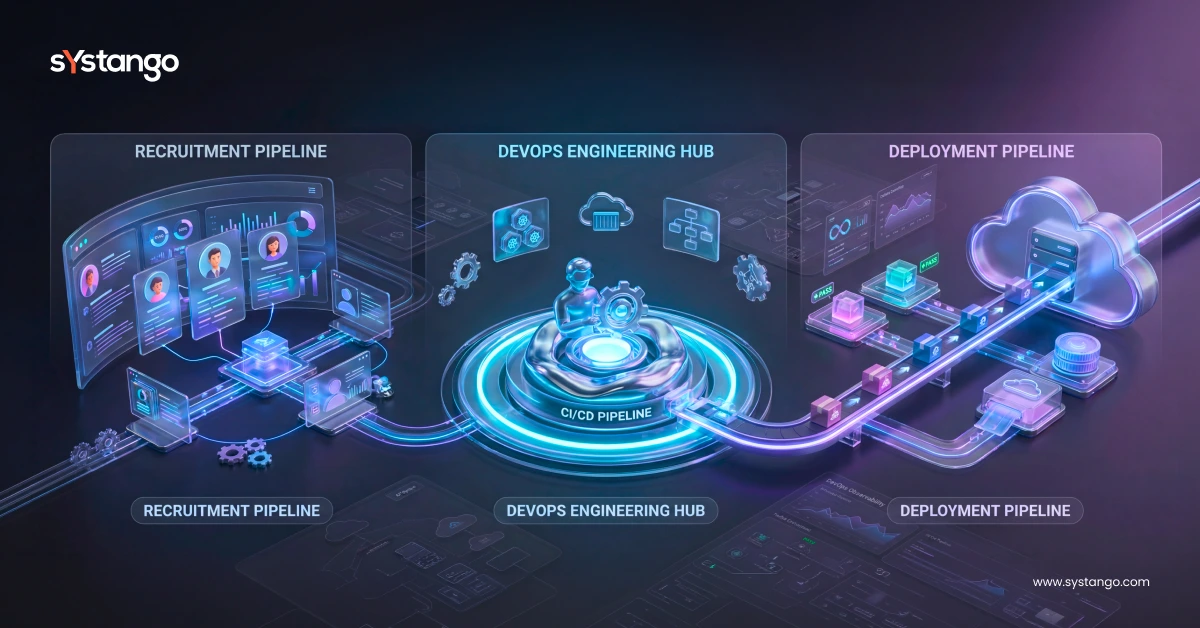
Hiring DevOps talent has become one of the most competitive challenges in tech. In 2026, DevOps is no longer just about automation or infrastructure it directly impacts speed, scalability, security, and cloud costs.
This DevOps engineer hiring guide explains how to hire a DevOps engineer, the latest DevOps hiring trends 2026, required skills, interview focus areas, and modern DevOps recruitment strategies including how AI is transforming DevOps talent acquisition.
Key Takeaways
- Hiring a DevOps engineer in 2026 requires cloud-native, automation-first, and security-focused expertise.
- Core skills include Kubernetes, Docker, Terraform, CI/CD, and cloud platforms (AWS, Azure, GCP).
- Modern DevOps hiring trends 2026 prioritise platform engineering, DevSecOps, and cost optimisation.
- The best DevOps recruitment strategies focus on capability building, not just role filling.
- AI-driven hiring tools are improving candidate screening, skill assessment, and hiring speed.
- Choosing the right hiring model freelancers, agencies, or consulting teams directly impacts scalability and delivery outcomes.
I. How to Hire a DevOps Engineer in 2026 (Modern Hiring Context)
To understand how to hire a DevOps engineer today, it’s important to recognize that DevOps roles have evolved into platform, cloud, and security-enabling positions.
Modern DevOps hiring focuses on:
- Cloud-native infrastructure
- Automation-first delivery
- Embedded security (DevSecOps)
- Reliability and observability
- Cost-aware cloud architecture
As a result, DevOps job description & skills must reflect real-world delivery needs—not outdated sysadmin checklists.
II. DevOps Hiring Trends 2026 You Must Know
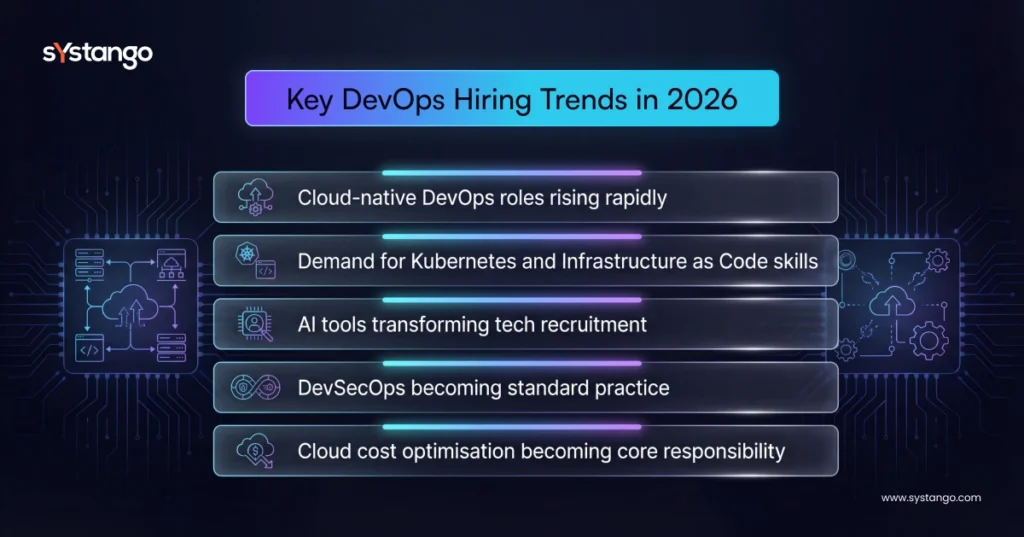
Before defining your hiring process, align with these DevOps hiring trends 2026:
- Shift from “DevOps engineer” to platform and reliability-focused roles
- Heavy demand for Kubernetes, Docker, and Infrastructure as Code (IaC)
- Increased use of AI recruiter tools for tech hiring
- Growing reliance on automated skills assessment DevOps
- Security-first pipelines replacing post-release audits
- Cloud cost optimisation becoming a core responsibility
Ignoring these trends is one of the biggest reasons DevOps hires fail.
III. What Does a DevOps Engineer Do Today?
A DevOps engineer designs and maintains systems that enable continuous, secure, and scalable software delivery.
They are responsible for:
- CI/CD pipeline design and management (CI/CD)
- Cloud infrastructure across AWS, Azure, and GCP
- Containerization using Docker and orchestration via Kubernetes
- Automation using DevOps automation tools
- Cloud reliability, monitoring, and incident response
- Implementing DevOps security best practices
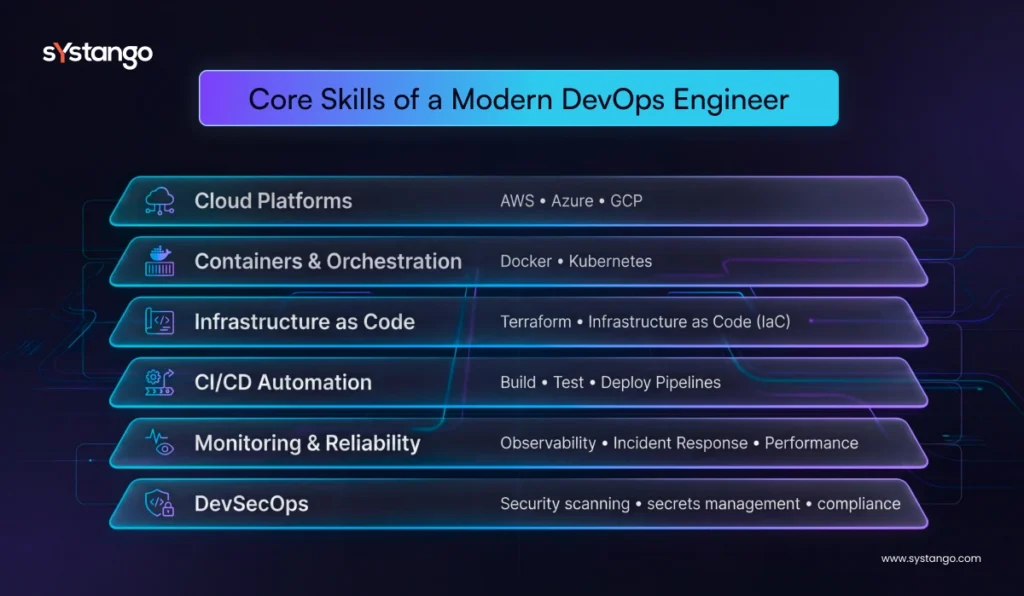
IV. DevOps Job Description & Skills: What to Look For
1. Cloud Architecture & System Administration
Strong cloud architecture skills form the foundation of modern DevOps.
Look for experience in:
- Linux system administration
- Cloud networking and load balancing
- Monitoring and observability
- Disaster recovery and backups
- Performance optimisation
2. Cloud Platforms, Containers & Virtualization
A strong DevOps engineer must work confidently across:
- AWS, Azure, and GCP
- Container platforms using Docker
- Orchestration with Kubernetes
These skills ensure scalable, resilient systems across environments.
3. Infrastructure as Code (IaC)
Infrastructure as Code (IaC) is now non-negotiable.
Expect proficiency in:
- Terraform for provisioning
- Version-controlled infrastructure
- Repeatable, auditable deployments
- Environment consistency across stages
IaC reduces errors, improves security, and accelerates delivery.
4. CI/CD & DevOps Automation Tools
Automation is the backbone of DevOps.
Look for hands-on experience with:
- CI/CD pipeline design (CI/CD)
- Build, test, and deployment automation
- Tool selection based on use cases
- Troubleshooting failed pipelines
- Scaling pipelines across teams
Strong automation directly impacts time-to-market.
5. Coding & Scripting
DevOps engineers don’t ship features but they write code daily.
Key capabilities:
- Scripting for automation
- Pipeline logic and tooling
- Integration between systems
- Debugging build and deployment issues
Coding enables DevOps engineers to eliminate manual bottlenecks.
6. Security & DevSecOps
Security must be embedded not bolted on.
Strong candidates demonstrate:
- DevOps security best practices
- Secure cloud architecture
- Secrets management
- Vulnerability scanning
- Compliance-ready deployments
- Backup and recovery planning
7. Testing, Monitoring & Reliability Engineering
Modern DevOps emphasizes prevention over firefighting.
Look for:
- Observability and monitoring strategy
- Automated testing integration
- Root cause analysis
- Reliability engineering principles
V. DevOps Interview Questions: What to Assess
Effective DevOps interview questions focus on real-world scenarios, not trivia.
Key areas to test:
- Designing CI/CD pipelines at scale
- Handling cloud failures and outages
- Implementing Infrastructure as Code (IaC)
- Securing pipelines and environments
- optimising cloud costs
- Working with Kubernetes in production
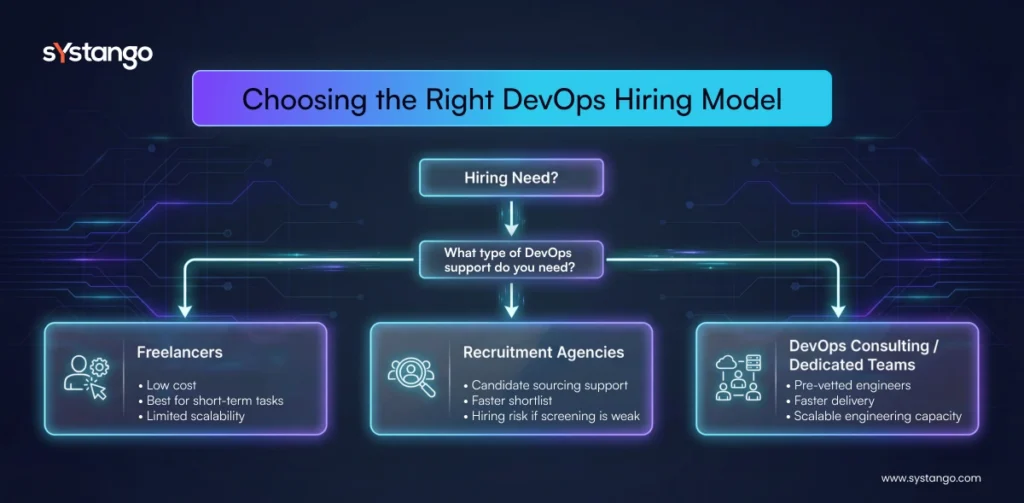
VI. DevOps Recruitment Strategies: Hiring Models Compared
1. Freelancers
Best for short-term or experimental needs.
Pros
- Cost-effective for small tasks
- Quick onboarding
Cons
- Limited accountability
- Hard to scale
- Time-zone challenges
2. Recruitment Agencies
Outsource sourcing and screening.
Pros
- Saves internal hiring time
- Access to candidate pools
Cons
- High fees
- Limited process control
- Slow iteration
3. DevOps Consulting & Dedicated Teams (Best for Scale)
This is the most effective approach for long-term success.
Benefits include:
- Faster DevOps talent acquisition
- Pre-vetted experts
- Flexible scaling
- Reduced hiring risk
- Proven delivery frameworks
VII. How AI Is Transforming DevOps Talent Acquisition
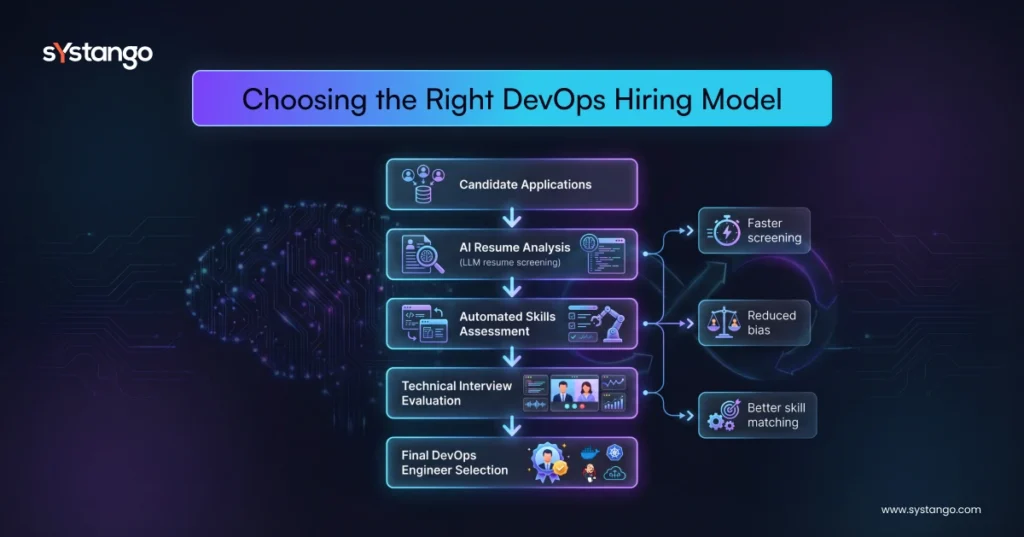
AI is rapidly reshaping how companies hire DevOps engineers.
Modern teams now use:
- AI tools for DevOps candidate screening
- LLM resume analysis DevOps hiring
- AI recruiter tools for tech hiring
- Automated skills assessment DevOps
- AI-assisted DevOps talent pipeline
AI improves speed, consistency, and fairness—especially when combined with human judgment.
IX. How Systango Supports DevOps Hiring at Scale
Systango helps companies build high-performing DevOps teams without recruitment friction.
Process:
- Understand business goals and technical needs
- Define DevOps roles and skill requirements
- Assemble best-fit DevOps engineers
- Enable final interviews
- Seamlessly integrate into delivery workflows
Why Systango:
- Proven DevOps recruitment strategies
- Faster releases and deployments
- Cloud cost optimisation
- Partnerships with AWS, Azure, and GCP
- Expertise across CI/CD, security, monitoring, and automation
Strategic Summary
This guide explains how to hire a DevOps engineer in 2026, covering DevOps hiring trends 2026, required DevOps job description & skills, and modern DevOps recruitment strategies. It explores key technical capabilities such as Kubernetes, Docker, Terraform, CI/CD, Infrastructure as Code (IaC), and cloud platforms including AWS, Azure, and GCP.
The article also highlights how AI is transforming DevOps talent acquisition through automated screening, LLM-based resume analysis, and intelligent skill assessments. It compares hiring models—freelancers, recruitment agencies, and DevOps consulting teams and explains how businesses can build scalable, secure, and high-performing DevOps capabilities aligned with cloud architecture, automation, and DevOps security best practices.
Final Takeaway
Hiring DevOps engineers in 2026 is no longer about filling a single role—it’s about building delivery capability. Companies must align with evolving DevOps hiring trends 2026, define practical DevOps job description & skills, and adopt outcome-driven DevOps recruitment strategies that prioritize cloud, automation, security, and reliability.
Systango supports this shift by enabling faster and smarter DevOps talent acquisition through consulting-led hiring, access to pre-vetted DevOps engineers, and flexible team models. With deep expertise in Infrastructure as Code (IaC), CI/CD, cloud platforms (AWS, Azure, GCP), and DevOps security best practices, Systango helps organizations reduce hiring risk while accelerating releases, improving system stability, and scaling with confidence.
Executive Summary
Hiring DevOps engineers in 2026 has become a strategic priority as businesses scale cloud infrastructure, automate delivery pipelines, and embed security into development workflows. Modern DevOps roles extend beyond traditional system administration to include platform engineering, Infrastructure as Code (IaC), CI/CD automation, and cloud cost optimisation.
This guide outlines how to hire a DevOps engineer effectively by aligning with current DevOps hiring trends 2026, identifying essential DevOps job description & skills, and implementing outcome-driven DevOps recruitment strategies. It also explores how AI is transforming DevOps talent acquisition by improving candidate screening, reducing bias, and accelerating hiring cycles.
Organisations that adopt the right hiring approach—combining technical evaluation, scalable hiring models, and AI-assisted recruitment—can build resilient DevOps teams that improve release velocity, system reliability, and overall business agility.