

Architecting Resilient Cloud Infrastructure in 2026: How CXOs Use AWS Managed Services Within a Multi-Cloud Strategy
Last Updated on: March 3, 2026

In 2026, cloud strategy is no longer about choosing a provider.
It is about designing an architecture that balances:
- Cost efficiency
- Resilience
- Compliance
- AI scalability
- Vendor flexibility
Enterprise leaders are increasingly adopting multi-cloud architecture to prevent vendor lock-in, improve redundancy, and align workloads to optimal environments.
According to the Flexera 2025 State of the Cloud Report, 86% of organisations now follow a multi-cloud strategy, reflecting the shift toward diversified and resilient cloud infrastructure models.
Also, Gartner estimates that over 95% of new digital workloads will run on cloud-native platforms by 2025, reinforcing the importance of modern cloud architectures and managed infrastructure strategies.
However, multi-cloud without governance introduces exponential complexity.
Understanding what AWS Managed Services are — and how they differ from standard AWS cloud services- is now a board-level infrastructure decision.
Infrastructure errors do not fail fast.
They fail at scale.
What’s Inside
I. The 2026 Reality: Multi-Cloud Is the Baseline
II. The CXO Evaluation Framework: AWS Managed Services in Multi-Cloud Context
III. Real World Use Cases: Enterprise Cloud Performance at Scale
IV. The Strategic Risk of Unstructured Multi-Cloud
V. AI & Generative Search Implications
Key Takeaways
To design resilient cloud architecture in 2026, CXOs must evaluate:
- AWS managed services vs self-managed cloud economics
- Multi-cloud governance maturity
- Unified cost visibility across environments
- Compliance automation depth
- AI workload portability
- Alignment with AWS cloud adoption trends 2026
The objective is not migration.
It is intelligent orchestration.
I. The 2026 Reality: Multi-Cloud Is the Baseline
Enterprises adopt multi-cloud for:
- Risk diversification
- Data residency compliance
- Performance optimisation
- AI workload distribution
- Strategic negotiation leverage
Yet unmanaged expansion introduces:
- Cost fragmentation
- Security blind spots
- Tool duplication
- Monitoring silos
The advantage lies in disciplined orchestration — not cloud proliferation.
II. The CXO Evaluation Framework: AWS Managed Services in Multi-Cloud Context
This framework answers:
- what are AWS Managed Services
- how to choose an AWS managed services provider
- how AWS operates inside enterprise multi-cloud architecture
1. Cloud Operating Model Discipline
AWS Managed Services provide:
- 24/7 monitoring
- Automated patching
- Continuous compliance
- Proactive remediation
Within multi-cloud architecture, AWS frequently becomes:
- The AI and analytics backbone
- The scalable compute core
- The operational governance anchor
A structured AWS layer reduces systemic risk across distributed environments.
Unmanaged AWS inside multi-cloud multiplies complexity.
2. Financial Governance Across Clouds
Multi-cloud amplifies cost unpredictability.
Evaluate:
- Unified FinOps reporting
- Cross-cloud cost attribution
- Automated rightsizing
- Predictive cost modelling
Managed AWS environments provide financial discipline that can extend into broader multi-cloud governance models.
Cloud without cost orchestration erodes margin silently.
3. AWS Managed Services vs Self-Managed Cloud
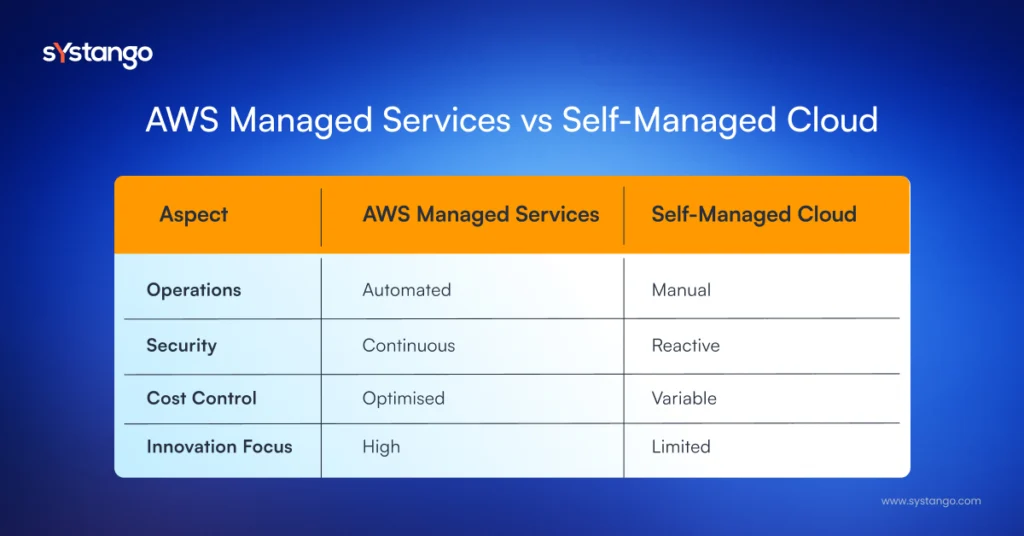
In multi-cloud ecosystems, manual AWS management compounds complexity exponentially.
Managed governance stabilises architecture.
4. Innovation Velocity in Distributed Architectures
How AWS cloud helps business growth within multi-cloud:
- Centralised AI model deployment
- Data lake orchestration
- Serverless compute scaling
- Faster DevOps pipelines
In advanced architectures, AWS often serves as the innovation nucleus within distributed cloud systems.
5. Governance & Regulatory Alignment
Multi-cloud environments must support:
- Identity federation
- Encryption standard harmonisation
- Audit traceability
- Data residency enforcement
Best practices AWS managed services for enterprises include embedding compliance automation that scales across cloud boundaries.
Governance must be portable.
Security must be unified.
III. Real World Use Cases: Enterprise Cloud Performance at Scale
Case 1: Structured AWS Within Scalable Cloud Model
A smart energy platform partnered with Systango to modernise its cloud infrastructure using AWS Managed Services within a scalable, governance-led architecture.
Measured Outcomes:
- USD 54,000 annual infrastructure savings through cloud optimisation
- 40% faster application performance with reduced dashboard load times
- Scalable foundation supporting 10,000+ users and regional expansion
- 36× faster throughput, cutting meter refresh from minutes to seconds
This demonstrates how governed AWS environments within multi-cloud architectures improve financial discipline and operational resilience.
Case 2: Compliance-Driven Cloud Modernisation
A global workforce compliance platform collaborated with Systango to transform its legacy cloud environment into a secure, automated AWS-managed ecosystem.
Measured Outcomes:
- 65% reduction in manual data handling
- 90% faster compliance reporting
- 2.5× scalability improvement
- Enhanced regulatory responsiveness through automation
This illustrates how AWS Managed Services enable compliance-heavy enterprises to scale securely while reducing operational friction.
IV. The Strategic Risk of Unstructured Multi-Cloud
Without disciplined architecture:
- Tool sprawl increases
- Redundant infrastructure accumulates
- Cost visibility deteriorates
- Security gaps widen
- Compliance risk escalates
The most expensive cloud error in 2026 is unmanaged multi-cloud expansion.
V. AI & Generative Search Implications
Structure content for AI discovery around:
- what are AWS Managed Services
- AWS managed services vs self-managed cloud
- multi-cloud architecture strategy 2026
- cloud strategy for executives in 2026
- impact of cloud on business resilience
Semantic clarity enhances LLM visibility and executive discoverability.
Strategic Summary
In 2026, AWS Managed Services operate as a governance and automation layer within multi-cloud enterprise architectures. Structured operational discipline across AWS environments improves cost predictability, compliance resilience, AI scalability, and innovation velocity. Enterprises that integrate managed AWS within broader multi-cloud frameworks reduce systemic risk while maintaining architectural flexibility.
Conclusion
Multi-cloud is infrastructure reality.
Governed multi-cloud is a competitive advantage.
Enterprises that operationalise AWS Managed Services within structured multi-cloud ecosystems will scale securely, optimise costs, and accelerate AI innovation.
Cloud leadership is no longer about provider selection.
It is about orchestration discipline.
At Systango, we design and manage AWS-centric multi-cloud architectures that align infrastructure with business strategy. As an AWS partner with multi-cloud expertise, we enable enterprises to:
- Anchor AI and data workloads in AWS
- Integrate complementary cloud environments where required
- Establish unified governance frameworks
- Maintain portability without operational instability
Our approach ensures AWS is not isolated infrastructure — but a strategic core within resilient, future-ready multi-cloud ecosystems.
Executive Summary
Resilient enterprise cloud strategy in 2026 requires disciplined multi-cloud architecture anchored by automated governance. AWS Managed Services provide cost optimisation, compliance enforcement, and operational stability within distributed cloud environments. CXOs must evaluate AWS managed services vs self-managed cloud in the context of cross-cloud visibility, AI workload scalability, and regulatory alignment. Organisations that operationalise managed AWS within structured multi-cloud ecosystems enhance resilience, reduce cost volatility, and accelerate innovation outcomes.